Calorie Deficit Calculator: Your Daily Target and Goal Weight Date
The Calorie Deficit Calculator turns your TDEE and weight-loss goal into a safe daily calorie target and projects the date you reach your goal weight.
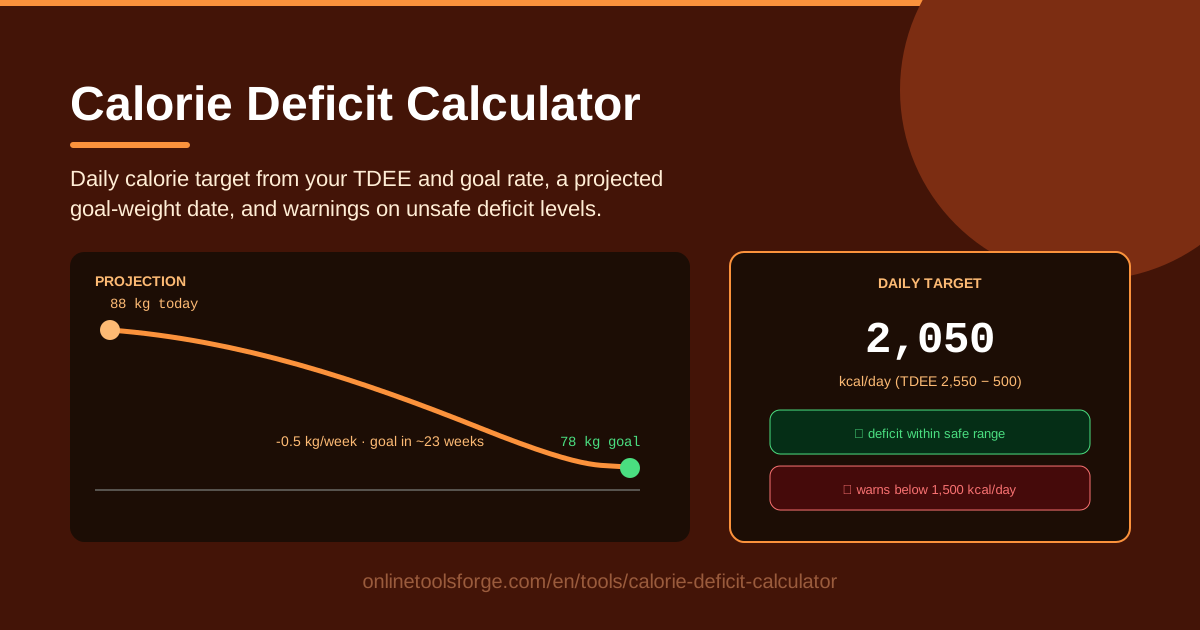
Table of Contents
Losing weight is simple arithmetic in uncomfortable clothing: eat fewer calories than you burn, but not so many fewer that you feel miserable, lose muscle, or quit within a month. The free Calorie Deficit Calculator turns that arithmetic into a personal plan in seconds. Enter your TDEE (total daily energy expenditure) and your goal weight-loss rate, and it computes your daily calorie target, projects when you will reach your goal weight, and warns you the moment the planned deficit becomes unsafe.
Most diets fail not from weak willpower but from picking a calorie number out of thin air. A target with no link to your actual burn rate is either uselessly gentle or punishingly strict, and both roads lead to a stalled scale. This calculator anchors every number to your metabolism, and it runs entirely in your browser: no account, no uploads, results in milliseconds.
Why Use Calorie Deficit Calculator?
- Turns a vague goal into a daily number. "I want to lose weight" is not a plan; the calculator converts it into a calorie figure you can apply to every meal, starting today.
- Projects your goal weight date. See an estimated finish line: the date the math says you reach your goal weight at your chosen pace.
- Warns on unsafe deficits. Cutting too aggressively invites muscle loss, fatigue, and rebound; the tool flags an extreme rate before you commit to it.
- Built on TDEE, not a generic chart. The same 1,600 calories mean very different things to a 50 kg office worker and a 105 kg athlete; anchoring to TDEE keeps the advice proportional.
- Lets you trade speed against comfort. Nudge the weekly rate up or down and watch the target and date respond, then pick a pace you can genuinely live with.
- Free, private, and instant. No sign-up and no server round-trips; recalculate in seconds whenever your weight or activity changes.
Key Features
| Feature | What it does |
|---|---|
| TDEE input | The calories you burn on a normal day, so every output fits your real metabolism. |
| Goal weight-loss rate | Choose your pace, typically 0.25–1.0 kg per week; the required deficit is derived from it. |
| Daily calorie target | One clear number: your TDEE minus the deficit your chosen pace demands. |
| Goal weight date projection | An estimated calendar date for reaching your goal weight at that pace. |
| Unsafe deficit warning | A visible alert when your inputs imply a deficit too aggressive for safe, sustainable loss. |
| Runs in the browser | All math happens locally on your device — instant and private. |
A few rows deserve a closer look:
- The single daily target is deliberate: one clear number is far easier to follow than weekly averages that require mental bookkeeping.
- The projection doubles as motivation — a steady 0.5 kg per week reads as "about twenty weeks," making patience feel rational.
- The warning exists because the classic failure is not one hungry day; it is an unsustainable deficit held for two months, followed by rebound.
How to Use Calorie Deficit Calculator
- Enter your TDEE. This is the number of calories you burn on a typical day; use a TDEE estimate from this site if you are unsure.
- Set your weekly weight-loss rate. Most people do best between 0.25 and 0.75 kg per week; larger bodies can hold the upper end.
- Read your daily calorie target. Your TDEE minus the deficit implied by your rate — the number to eat toward each day.
- Check the projected goal date. Sanity-check the estimated finish line against any real-world deadline, then adjust the rate if needed.
- Heed the safety warnings. If the tool flags your rate as too aggressive, slow down or accept a later date — a warning in week zero costs far less than burnout in week five.
Deficits, TDEE and Sustainable Rates
TDEE — total daily energy expenditure — is everything your body burns in 24 hours: your basal metabolic rate (staying alive, usually 60–70% of the total), non-exercise movement like walking and chores, formal exercise, and the thermic effect of food. Subtracting from this realistic total is why a TDEE-based target beats any one-size-fits-all chart.
Why does a 500 calorie deficit dominate weight-loss advice? Because a kilogram of body fat stores roughly 7,700 calories. Five hundred a day accumulates to about 3,500 per week and 15,400 per month — close to half a kilogram of fat per week. The arithmetic is imperfect, but dependable enough for planning, which is why sensible rates cluster between 0.25 and 0.75 kg weekly.
Safe guardrails: keep the deficit at or below roughly 20–25% of your TDEE; keep weekly loss at or below about 1% of body weight; and stay above commonly cited floors of 1,200 calories for women or 1,500 for men unless a professional supervises. Going faster genuinely backfires: severe deficits burn lean muscle alongside fat, wreck sleep and training, crank up hunger until adherence snaps, and make rebound the likely ending. A 0.5 kg pace held for twenty weeks beats a 1.5 kg pace abandoned in four, every time.
Treat the projected date as a trend, not a promise. Early drops are mostly water and glycogen, plateaus appear as your shrinking body burns less, and hormones add their own noise. None of that breaks the math; it means recalculate with fresh inputs every few weeks.
Practical Use Cases
Planning a 10 kg cut before an event
You weigh 88 kg with a TDEE of 2,400 and want to reach 78 kg before a beach trip. At 0.5 kg per week the calculator returns a daily target near 1,900 calories and a goal date about twenty weeks out. Need it faster? Try 0.75 kg per week: roughly 1,775 calories and thirteen weeks, still inside safe guardrails. That trade-off, visible in seconds, is the point.
Reversing a slow gain
Weight creeping on at a kilo every four months is easy to ignore and expensive to ignore. Run the numbers at a gentle 0.25–0.3 kg per week and the required deficit turns out tiny — often 250–300 calories, the price of one snack and one sugary drink. Catching a slow gain early turns a future 12 kg problem into a four-month adjustment that barely feels like a diet.
Pairing the deficit with a macro plan
A calorie target says how much to eat; macros say what. Once you have your daily calories, split them protein-first — roughly 1.6–2.2 g per kg of body weight — to protect muscle while the deficit does its work. Our macro calculator picks up exactly where this one leaves off.
Maintenance break planning
Long cuts go better with scheduled diet breaks: seven to fourteen days eating at TDEE to restore hormones, training drive, and sanity. Knowing your deficit and target lets you build a cut-then-break calendar where the projected date simply stretches to include each pause, keeping the finish line honest.
Best Practices
- Recalculate as you lose. TDEE falls with body weight; refresh your inputs every 4–5 kg of progress or the target quietly stops working.
- Prioritize protein. High protein inside a deficit is your insurance policy for muscle, fullness, and training quality.
- Weigh weekly, not daily. Daily weight swings 1–2 kg on water and food volume; weekly averages reveal the real trend.
- Treat the projection as a trend, not a promise. Expect an early whoosh and a plateau or two; the date is approximately right, not exactly right.
- Never argue with the warning. If the calculator flags your rate as unsafe, believe it and slow down.
- Pair the number with strength training. A modest deficit plus resistance work preserves muscle, so progress shows in the mirror, not just on the scale.
Ready to turn your goal into a number? Open the Calorie Deficit Calculator, enter your TDEE, choose a pace you can live with, and let the daily target — and the finish line — take care of themselves.
Related Tools You Might Like:
- BMI Calculator — see where your current weight sits before setting a goal.
- Macro Calculator — split your new calorie target into protein, carbs, and fat.
- Interval Timer — add calorie-burning interval sessions on a precise timer.
Happy tracking!
Frequently Asked Questions
Q: How big should my calorie deficit be? A: For most people, 300–500 calories per day — roughly 0.25–0.5 kg of loss per week. Keep it within about 20–25% of your TDEE, and let the calculator's safety warning be your backstop.
Q: Is a 1,000 calorie deficit safe? A: Rarely, and only for heavier individuals with professional guidance. For most people intake falls below healthy floors, muscle loss accelerates, and rebound becomes likely. If the calculator warns you, lower your weekly rate.
Q: How accurate is the goal weight date projection? A: Treat it as a well-informed estimate. Water fluctuations, plateaus, and the gradual drop in TDEE can shift the real date by days or weeks; recalculate with updated inputs to stay useful.
Q: Should I eat back the calories I burn exercising? A: If your TDEE already includes your typical activity, no — the deficit already accounts for it. Only add modestly on unusually intense days.