Fishtank Glass Thickness Calculator: The Complete DIY Tank Safety Guide
The free Fishtank Glass Thickness Calculator recommends aquarium glass thickness and safety factor from your tank dimensions, with water volume and filled weight — before you cut a single pane.
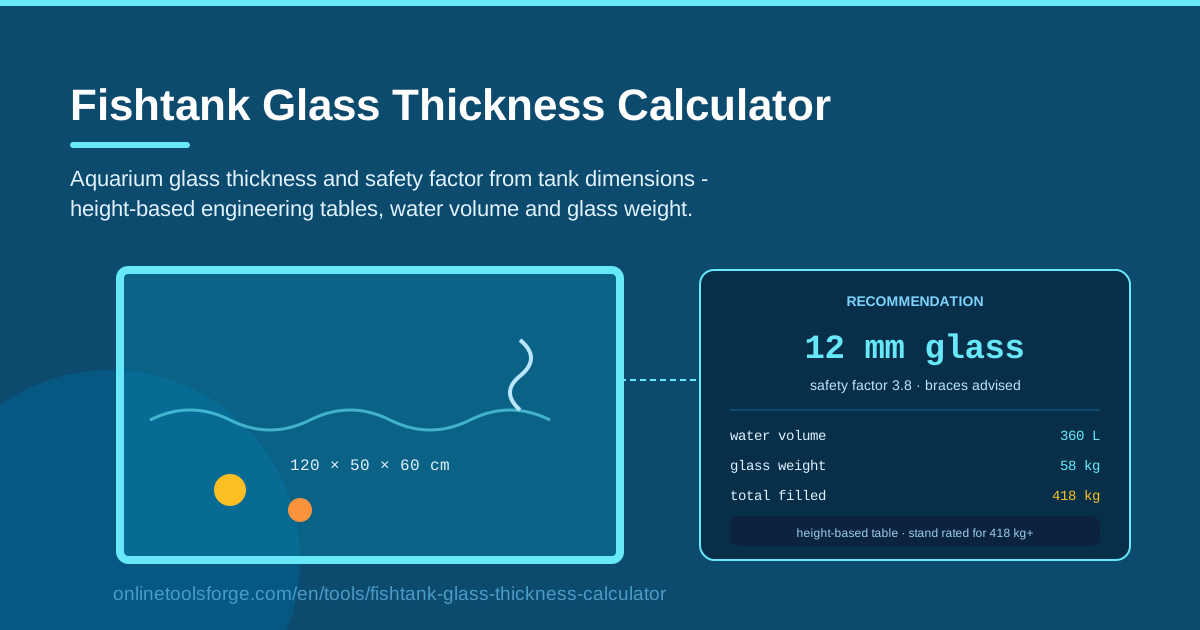
Table of Contents
Building your own aquarium is one of the most rewarding projects in the hobby, but it hinges on one number most people guess: glass thickness. Too thin and a seam can fail; too thick and you pay for weight and cost you never needed. The Fishtank Glass Thickness Calculator removes the guesswork by reading height-based engineering tables for you and returning a safe recommendation in seconds.
The tool runs entirely in your browser. Enter your tank's length, width, and height, and it recommends a glass thickness with an appropriate safety factor. Alongside that it computes water volume, the weight of the glass itself, and the total filled weight — the number your stand and your floor actually have to carry.
In this guide we walk through how to use the calculator step by step, why water depth matters more than tank length in glass math, and how to apply the results to real projects, from rimless builds to secondhand bargains.
Why Use Fishtank Glass Thickness Calculator?
- Avoid a 400-liter flood in your living room. A 400-liter tank holds more than 400 kilograms of water, and a seam that lets go releases all of it in minutes. Sizing glass correctly is the cheapest insurance you will ever buy.
- Stop trusting forum rules of thumb. "6 mm for anything under a meter" is how tanks fail. Engineering tables keyed to water height exist for a reason, and the calculator applies them consistently every time.
- Understand your safety factor. Instead of a bare millimeter figure, you see the actual margin the recommendation carries, so you can judge whether 8 mm is comfortable or merely adequate for your build.
- Know the true weight before delivery day. Water volume, glass weight, and total filled weight tell you whether your stand — and your floor — can handle the load.
- Plan rimless builds with confidence. With no plastic rim to help, the glass carries every load alone; a height-based recommendation is the honest starting point.
- Free, instant, and private. No signup, no uploads — every calculation runs client-side in your browser.
Key Features
| Feature | What it does |
|---|---|
| Dimension input | Enter tank length, width, and height; the tool sanity-checks the proportions. |
| Glass thickness recommendation | Matches your water height to height-based engineering tables and suggests a thickness. |
| Safety factor display | Shows how much margin the recommendation carries above the calculated stress. |
| Water volume | Computes capacity so you can dose treatments and size filtration correctly. |
| Glass weight | Estimates the weight of the panes for cutting, transport, and handling plans. |
| Total filled weight | Sums water and glass so your stand and floor are sized honestly. |
A few details worth calling out:
- Everything updates as you type, so comparing a 45 cm tall tank against a 50 cm tall one takes seconds.
- The recommendation is conservative: where a table offers a range, the tool stays on the safe side.
- It doubles as an aquarium volume calculator and weight estimator, all on one screen.
How to Use Fishtank Glass Thickness Calculator
- Enter your dimensions. Measure the planned length, width, and height (or water line) of your tank and type them in. Designing from scratch? Try several heights and watch how the recommendation reacts.
- Read the recommended thickness. The tool returns the glass thickness your water height requires, drawn from height-based engineering tables. Treat it as your minimum, not a figure to negotiate down.
- Check the safety factor. Home aquariums are commonly engineered with a factor near 3.8. If your build sits near a table boundary, stepping up one glass size is cheap peace of mind.
- Plan your bracing. If the tank is long relative to its height, plan a center brace or eurobracing so the long panels are supported at mid-span. The tables assume a reasonable unsupported span, not an open 150 cm run.
- Note the filled weight. Before buying anything, check the total filled weight and confirm your stand and floor can carry it. Write the number down — it drives stand choice, placement, and moving-day logistics.
Why Height Beats Length in Glass Math
The most misunderstood fact about aquarium glass is that water pressure depends on depth, not volume. Pressure at the bottom of a tank is simply the weight of the water column above a given area, and a 60 cm tall column pushes equally hard whether the tank is 30 cm wide or 3 meters wide. That is why a small but tall nano tank can burst while a huge, shallow sump happily runs on 6 mm glass.
Because pressure scales with depth, thickness requirements scale with height too — and faster than height itself. Engineering tables for aquarium glass are built exactly this way: for each water height they list the minimum pane thickness at a defined safety factor. Raise the waterline from 30 cm to 60 cm and the required thickness far more than doubles, which is why the small tank runs on 6 mm while the taller one may need 12–15 mm.
The safety factor is the ratio between the glass's breaking strength and the stress the water actually produces. Glass is enormously strong in theory but variable in practice — scratches, chips, and edge flaws all reduce real-world strength. A factor near 3.8, the common home-aquarium standard, means a pane should survive roughly four times its working load; public display tanks push the factor higher because failure is unacceptable.
Bracing and rim frames change the picture as well. A plastic rim or a glass center brace shortens the unsupported span of a long panel, cutting bending stress and letting a thinner pane work safely. Rimless tanks forgo all of that, so the panels must carry the full load unassisted — one more reason to trust the height-based table instead of a length-based guess.
Material matters too. Acrylic is lighter and clearer but flexes far more than glass, so it typically needs roughly double the thickness at the same height; glass is stiffer, scratch-resistant, and cheaper, which is why it dominates home aquariums.
Finally, respect floor load. A 400-liter tank plus glass, stand, and substrate can exceed 550 kilograms concentrated on a footprint smaller than a doormat. On wooden upper floors, run the tank along a load-bearing wall or perpendicular to the joists, and let the filled-weight figure guide placement.
Practical Use Cases
Planning a DIY Rimless Tank
You want a 90 × 45 × 45 cm rimless planted tank. Enter the dimensions and the calculator recommends roughly 8–10 mm glass with the safety factor displayed. Because rimless panels are unsupported, you choose 10 mm low-iron glass with polished edges. The volume figure — about 180 liters — also sizes your filter and heater before you order anything.
Checking a Secondhand Tank Before You Buy
A marketplace listing offers a "120 × 50 × 50, 10 mm glass" tank. Run the numbers: at 50 cm of water height the recommendation confirms 10 mm is appropriate, the 300-liter volume matches the seller's claim, and a filled weight near 350 kilograms tells you it will not be a two-person carry. You negotiate with facts instead of hope.
Matching a Planted Tank to Its Stand
Your stand is rated for 250 kilograms, but the tank you wanted weighs about 350 kilograms filled. Rather than gamble, you step down to 100 × 40 × 45, rerun the calculator, and land comfortably inside the rating with the recommended 8 mm glass — thinner than you feared, because the height stays moderate.
Apartment Floor Safety for Big Tanks
Before committing to a 150 × 50 × 60 tank, you check the filled weight: roughly 500 liters of water plus heavy 12 mm panes puts the total well over 550 kilograms on a small footprint. With that number in hand you consult your landlord, and position the tank along a load-bearing wall instead of mid-room on an older floor.
Best Practices
- Never go below the recommended thickness. The table already includes a safety factor; trimming a millimeter silently removes it.
- Prefer taller-safe proportions over long-and-thin. Growing length is cheap, but pushing height drives thickness — pick the axis your glass budget can afford.
- Level the stand perfectly. A twisted stand loads glass edges unevenly, and edges are where tanks fail; shim and recheck after filling.
- Add bracing for long spans. Any panel run much longer than its height deserves a center brace, even when thickness is technically adequate.
- Specify polished, chip-free edges. Edge flaws are stress risers; inspect every pane before assembly.
- Leave headroom at the water line. Filling to the brim adds pressure with no margin — plan a few centimeters of freeboard.
Ready to size your build? Open the Fishtank Glass Thickness Calculator, enter your dimensions, and get a thickness, safety factor, volume, and filled-weight readout in under a minute — free, and entirely in your browser.
Related Tools You Might Like:
- Pool Volume Calculator — size pools and water changes with the same depth-based math.
- Unit Converter — switch between centimeters, inches, liters, and gallons instantly.
- Scientific Calculator — verify pressure and load figures by hand.
Happy building — and may every seam hold!
Frequently Asked Questions
Q: How thick should aquarium glass be for a 4-foot tank? A: It depends mainly on height, not length. A 120 × 45 × 45 cm tank needs around 8 mm at a 3.8 safety factor, while a 50 cm tall 4-foot tank generally calls for 10 mm — and rimless builds should take the higher end. Enter your exact dimensions in the calculator for the height-specific recommendation.
Q: Is thicker glass always safer? A: Thicker is stronger, but beyond the recommended thickness the extra millimeters mostly add weight and cost. A correct thickness, good silicone work, and a level stand protect your tank far more than simply maxing out the pane size.
Q: Can I use this calculator for an acrylic tank? A: The tables are calibrated for glass. Acrylic flexes much more and usually needs about double the thickness at the same height, so treat the glass result as a starting point and consult acrylic-specific guidance before building.
Q: Is my data uploaded anywhere? A: No. The calculator runs entirely client-side in your browser — your dimensions never leave your device, and no account is required.