Carton Capacity Calculator: Nail Items Per Carton and Cartons Per Container in Seconds
The Carton Capacity Calculator computes items per carton and cartons per pallet or container from your item and box dimensions, with orientation rotation and fill-ratio stats.
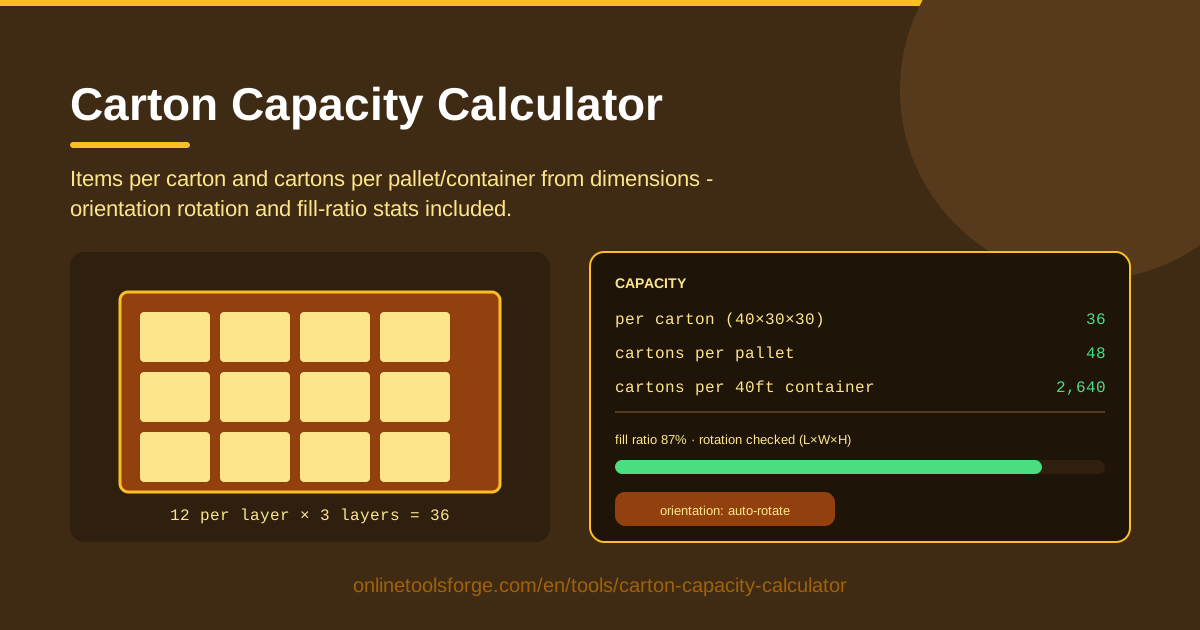
Table of Contents
Ask three people how many units fit in a shipping carton and you will get three different answers — and none of them will match what actually fits on the pallet. Packing math looks simple until you meet it in real life: a box that fits one way wastes centimeters another way, a carton that "should" hold 60 units holds 48, and a container quote built on 1,200 cartons comes back two pallets short.
The Carton Capacity Calculator ends the guesswork. Enter your item dimensions, enter your carton dimensions, and the tool instantly computes how many items fit per carton and how many cartons fit per pallet or container. It checks orientation rotation to find the best fit, and shows fill-ratio stats so you can see exactly how much of every carton is actually working for you.
Everything runs in your browser. No sign-up, no spreadsheet formulas, no phone call to your freight forwarder just to sanity-check a number that should take ten seconds.
Why Use Carton Capacity Calculator?
- Container quotes you can actually trust. Freight quotes are built on carton counts. If your count is wrong, the quote is wrong — and the correction usually arrives after you have committed to a booking. Run the numbers yourself before you request pricing.
- No more overhang surprises. A pallet that holds 5 cartons per layer on paper can hold 4 in real life the moment one carton edge creeps past the pallet footprint. Scaling cartons per pallet from real footprints surfaces that risk before the warehouse does.
- Rotation is checked automatically. Plenty of products fit 10–25% more per carton when the items are turned 90 degrees. The auto-rotate logic tests orientations so you never leave a whole layer on the table.
- Fill ratio exposes dead space. A 72% fill ratio means more than a quarter of your carton is air — and you are paying freight on that air, every shipment, all year.
- One workflow, three answers. Items per carton, cartons per pallet, cartons per container: the three counts every logistics conversation needs, produced in a single pass.
- Free, instant, browser-based. No accounts, no installs, no trial limits. Open the page, type your dimensions, get your counts.
Key Features
| Feature | What it does |
|---|---|
| Item dimension inputs | Enter the length, width and height of the product or retail box you are packing |
| Carton dimension inputs | Enter the internal length, width and height of the shipping carton |
| Items per carton | Computes how many units fit per layer and how many layers stack per carton |
| Cartons per pallet | Scales the carton footprint up to a full pallet layout |
| Cartons per container | Extends the count to a full container load for freight quoting |
| Orientation rotation | Auto-rotates the item for the best fit when a 90-degree turn gains capacity |
| Fill-ratio stats | Shows what percentage of the carton volume the contents actually occupy |
| Runs in the browser | All math executes locally on your device — nothing to install, nothing uploaded |
Two details deserve a closer look. First, the rotation check matters most with "awkward" rectangular items, where the wrong orientation quietly costs you a column of units on every layer. Second, the fill-ratio stats double as a void-fill warning: a low ratio means you are shipping air and risking product shift in transit, while a suspiciously high one leaves no headroom for cushioning.
How to Use Carton Capacity Calculator
- Enter your item dimensions. Measure the product — or its retail box, if you ship boxed goods — at its widest points, including any protruding handles or caps. Consistent units matter more than the unit system itself.
- Enter the carton's internal dimensions. Use the inside measurements of the shipping carton, not the outside. Corrugated walls eat several millimeters per side, and that difference compounds across every layer.
- Check the orientation rotation result. Compare the count with and without rotation. If rotating the item gains units per layer, the tool will surface the better fit — verify it matches how your line physically packs.
- Read your items-per-carton count. This is the number your pick-and-pack team and your unit-cost math both depend on. Note the fill ratio alongside it.
- Scale up to pallet and container. With the per-carton count confirmed, read the cartons-per-pallet and cartons-per-container results to size your shipment, book freight, and quote customers with confidence.
The Packing Math Behind Every Quote
The single most common packing mistake is trusting a volume-fit answer when the real constraint is floor-fit. Volume-fit says: carton volume divided by item volume, rounded down. Floor-fit says: how many items lie on the base layer, per axis, then how many layers stack. These rarely agree. Take a 40 × 30 × 30 cm carton and an 11 × 11 × 10 cm item. Volume math gives 36,000 ÷ 1,210 ≈ 29 units. Floor math gives 3 across × 2 across × 3 layers = 18. The 29 is a fantasy — the leftover sliver of width cannot fit a eleventh item lying sideways unless the geometry truly allows it, and it usually does not.
This is also why rotation can add an entire layer, not just a unit or two. If an item is 19 × 9 cm and the carton offers 38 cm of width, you fit two the long way — but rotated, four fit across. Four per row instead of two can double the layer count's payoff and turn 20 units per carton into 32. Multiply that across 100 cartons and rotation is the difference between one container and one and a half.
The fill-ratio stat is your early-warning system for both extremes. Below roughly 70%, you are shipping air: expect void fill costs, product shift damage claims, and wasted container space. Above roughly 95%, you have no headroom for cushioning, tape, or the natural bulge of poly bags — and cartons arrive crushed.
Scaling up adds two more constraints. Pallet footprints are standard (120 × 100 cm and 120 × 80 cm are the workhorses), so cartons per layer is a clean division — but stack height is limited twice: once by the container's internal height (about 2.39 m on a standard high-cube), and once by the crush strength of the bottom cartons, which carry the weight of everything above them. A pallet that "fits" nine layers may only survive five in a humid hold.
Finally, internal versus outer dimensions is where good math goes to die. A carton sold as "40 cm" is often 38.8 cm inside. Use internal dimensions for item-to-carton math and outer dimensions for carton-to-pallet and pallet-to-container math. Mixing them inflates every count slightly — and slightly wrong is how containers come up short.
Practical Use Cases
Quoting an e-commerce shipment
A seller ships 900 units of a 12 × 8 × 6 cm product monthly. At 12 units per carton, that is 75 cartons, which the calculator scales to 2 pallets and comfortably under one container load. Armed with exact counts, the seller requests an accurate freight quote instead of a padded "just in case" one — and the padding, repeated monthly, was quietly costing hundreds per year.
Choosing carton sizes for a product line
A brand is deciding between two stock cartons for a new product. Entering both cartons into the calculator shows the taller option jumps from 40 to 48 units per carton — 20% fewer cartons, fewer pallet positions, less packing labor per unit shipped. One five-minute check settles a decision that would otherwise be made on price per carton alone, ignoring the freight it drives.
Warehouse pallet planning
A warehouse manager needs to know how many cartons arrive per pallet before the delivery truck does. Running the carton dimensions through the tool yields cartons per layer and total layers per pallet, so rack space can be reserved, forklift plans set, and put-away teams staffed correctly — before goods hit the dock.
Comparing freight costs
Carrier A prices per pallet; carrier B prices per container. Without carton counts, the two quotes are incomparable. With items-per-carton and cartons-per-pallet in hand, you can convert both quotes into cost per unit shipped and choose on real economics instead of whichever salesperson called last.
Best Practices
- Always measure internal carton dimensions. Measure the inside of an actual carton with a tape, not the spec sheet's nominal size.
- Leave void-fill headroom. Target a fill ratio in the 75–90% range so fragile goods have cushioning space and cartons close without bulging.
- Respect stack crush limits. The calculator proves cartons fit; only a drop test or compression spec proves the bottom layer survives the stack above it.
- Re-check whenever packaging changes. A new supplier, a 5 mm thinner retail box, or a switch to double-wall corrugated all shift every count downstream. Recalculate before reprinting packing labels.
- Weigh, don't just count. Dimensional math optimizes space; pallet weight limits are a separate ceiling. Check both before booking.
- Keep a small reference sheet of item, carton, pallet and container counts for your core SKUs so quotes and labels never rely on memory.
Ready to stop guessing? Open the Carton Capacity Calculator, enter one item and one carton, and see your per-carton, per-pallet and container counts in seconds — free, in your browser.
Related Tools You Might Like:
- Tile Calculator — plan tile counts and coverage for any floor or wall area.
- Unit Converter — convert between metric and imperial units for international packaging specs.
- Square Footage Calculator — measure areas for warehouse layouts and storage planning.
Happy packing!
Frequently Asked Questions
Q: How does the calculator count items per carton? A: It divides the carton's internal length, width and height by your item's dimensions along each axis, rounds each result down to a whole unit, then multiplies the three numbers together. The rotation check repeats the calculation with the item turned 90 degrees and keeps whichever orientation fits more.
Q: Why is my volume-based estimate higher than the tool's result? A: Volume division assumes loose fill, but rigid items pack in a grid: the leftover space on each axis cannot be combined into whole extra items. Floor-fit math reflects what a packing line can actually do, which is why the tool's count is the one to plan around.
Q: What fill ratio should I aim for? A: Roughly 75–90% works well for most goods. Below that you are paying to ship air and risking transit damage; above it you leave no room for void fill, tape and carton bulge, which leads to crushed boxes.
Q: Does the tool work with any unit system? A: Yes. Enter all dimensions in the same unit — millimeters, centimeters or inches — and the counts stay correct, because the math depends only on consistent ratios between item, carton, pallet and container sizes.