Board Foot Calculator: Price Your Lumber Before You Buy
Use the free Board Foot Calculator to compute board feet and total lumber cost for multiple plank sizes, complete with wood species price presets and a waste allowance.
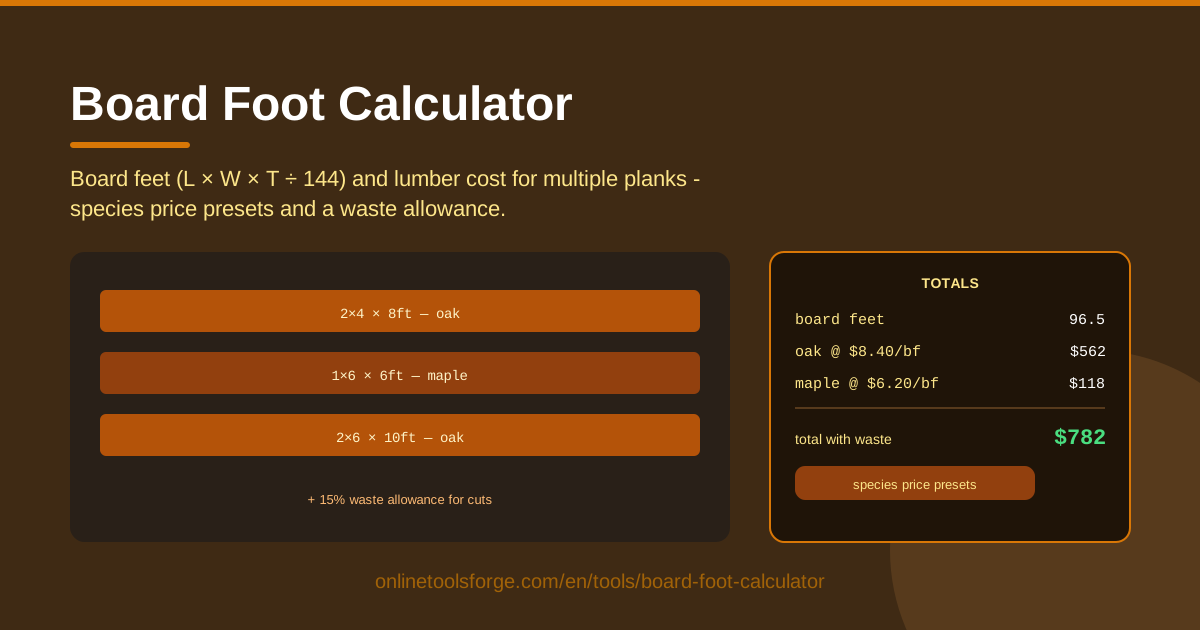
Table of Contents
Lumberyards price hardwood and specialty stock by the board foot, not by the piece, and if you have never run that math it can feel like a language you only half speak. The Board Foot Calculator translates those numbers for you: enter the length, width, and thickness of each plank, and it instantly converts your dimensions into board feet and dollars.
The tool is built for real projects rather than single-board guesses. You can stack as many plank rows as your design calls for, apply a wood species price preset such as oak, maple, or pine, and add a waste allowance so the final figure reflects the offcuts and defects that every project produces.
Whether you are ordering hardwood for a dining table, tallying pine for shop shelves, or checking a sawmill quote before you commit, this calculator hands you a defensible budget in under a minute. It runs entirely in your browser, with no signup and nothing to install.
Why Use Board Foot Calculator?
- Speak the lumberyard's language: Hardwood is sold by the board foot, so thinking in board feet lets you compare quotes and talk to suppliers with confidence.
- Kill budget surprises: A cost estimate built board foot by board foot is far more reliable than eyeballing a lumber rack and hoping for the best.
- Handle mixed plank sizes: Real projects use many dimensions. Separate rows for tabletop boards, aprons, and legs roll up into one tidy total.
- Compare wood species instantly: Flip from a pine preset to an oak preset and watch the same dimensions reprice in a second.
- Plan for waste like a pro: A built-in waste percentage covers saw kerf, offcuts, and the board you simply cannot use.
- Free and instant: It runs entirely in your browser, works on phone or desktop, and never asks for an account.
Key Features
| Feature | What it does |
|---|---|
| Multiple plank sizes | Enter length, width, and thickness for each plank and add as many rows as the project needs |
| Board foot engine | Applies the length × width × thickness ÷ 144 formula to every row automatically |
| Wood species price presets | One-click pricing for oak, maple, pine, and more |
| Waste allowance | Adds a percentage buffer for cuts, defects, and mistakes |
| Cost totals | Rolls every row into total board feet and a total lumber cost |
| Browser-based | Nothing to download; the calculation runs locally in your browser |
A few details worth calling out:
- Transparent decimals: The calculator shows board feet with decimals instead of rounding up to whole units, so a 4.17 board foot row is priced as 4.17.
- Presets are starting points: Species prices reflect typical yard rates, so treat them as sane defaults that you sanity-check against local quotes.
- Rerun freely: Change a dimension or swap species and every total updates immediately, so iterating on a design costs nothing.
How to Use Board Foot Calculator
- Add a plank row with its sizes. Enter the length, width, and thickness of one plank size, all in inches — an 8-foot board is 96 inches long. Need a second dimension, such as aprons or legs? Add another row.
- Pick a wood species preset. Choose oak, maple, pine, or another option to load a typical price per board foot for that lumber.
- Set your waste allowance. Enter a percentage — 10 percent is a common floor for straightforward builds, while 15 to 20 percent suits complex layouts or figured stock.
- Read the board feet. The calculator multiplies length × width × thickness and divides by 144 for every row, then shows the total board feet for the whole order.
- Read the total cost. Board feet priced at your species rate, plus the waste allowance, appear as a single lumber cost estimate you can take straight to the register.
The Board Foot Formula Demystified
A board foot is a unit of volume, not length: exactly 144 cubic inches of wood, which is a plank 12 inches long, 12 inches wide, and 1 inch thick. The formula the calculator applies — length × width × thickness ÷ 144 — simply counts how many of those 144-cubic-inch blocks fit inside your lumber.
Take an oak board 8 feet long, 6 inches wide, and 1 inch thick. That is 96 × 6 × 1 ÷ 144, which equals 4 board feet. Double the thickness to 2 inches and the same board becomes 8 board feet, even though its footprint never changed.
The nominal versus actual trap. Lumber is named by its rough, nominal size but sold after drying and surfacing. A "4/4" hardwood board is nominally 1 inch thick yet usually planes down to 13/16 or 3/4 of an inch, and the classic 2x4 is really about 1.5 × 3.5 inches. Yards price hardwood by nominal thickness quarters — 4/4, 6/4, 8/4 — so enter the nominal thickness when you want your numbers to match their tally, and actual measurements when you care about finished volume.
Why species changes the price per board foot. Board feet measure quantity; species sets value. Pine grows fast and is cheap, often just a few dollars per board foot. Oak sits mid-range, while maple, cherry, and walnut climb steeply. Because the rate is quoted per board foot, one preset swap reprices the entire order.
Why waste allowances matter. Between saw kerf, splits, checks, and the board you mis-cut at the very end, you will rarely use 100 percent of what you buy. Most woodworkers add 10 to 15 percent for simple projects and 20 percent or more for figured grain, live edges, or layouts packed with small parts.
Multiple line items add up correctly. A row of 1 x 8 x 72 tabletop boards contributes very different board feet than 8/4 legs, and each should be priced on its own volume. The calculator keeps every row separate, then sums board feet and cost into one honest total.
Practical Use Cases
Hardwood Purchase for Furniture
Suppose a dining table needs five top boards of 1 x 8 x 72 inches (20 board feet), four 8/4 legs at 2 x 3 x 29 inches (about 4.8 board feet), and four 1 x 4 x 60 aprons (about 6.7 board feet). That is roughly 32 board feet, or about 36 with 15 percent waste — around $325 at a $9 per board foot oak rate. Entering all of it takes less than a minute.
Comparing Oak vs Maple Budgets
Imagine the same 40 board foot project. White oak at $12 per board foot lands near $480, while hard maple at $7.50 lands near $300 — an $180 gap on identical dimensions. Swap the preset in the calculator and the decision makes itself.
Sawmill Order Checks
Local mills sell rough-sawn stock by their own tally. Enter the nominal thickness (8/4 as 2 inches) plus the lengths and widths from the mill's list, and compare your board foot total with theirs before you pay. A large mismatch is worth a polite question.
Woodworking Class Projects
An instructor budgeting cutting boards for 15 students can enter 3/4 x 8 x 16 inches per board — about 0.67 board feet each, 10 board feet total. Add 20 percent waste and price it with a maple preset at $8 per board foot: roughly $96, or $6.40 per student.
Best Practices
- Measure actual thickness after planing: Finished stock loses thickness, so use real measurements when the finished volume matters and nominal sizes when matching a yard's tally.
- Add realistic waste: Never budget at 0 percent, but do not pad past 25 percent without a reason either.
- Price-check local yards: Presets are reference rates, not quotes — call or visit before you order.
- Buy a bit extra of feature lumber: Grain-matched tops burn through boards, so set the showcase wood aside with headroom.
- Recalculate when the design changes: Every revision takes seconds, so keep the estimate current until the cut list is final.
Ready to stop guessing at the lumber counter? Open the Board Foot Calculator, enter your plank list, and walk into the yard knowing exactly what your project should cost.
Related Tools You Might Like:
Planning more building projects? These companion calculators estimate the rest of your materials:
- Decking Calculator — deck boards and fastener estimates
- Fence Calculator — posts, rails, and pickets for a fence run
- Roofing Calculator — squares and bundles for roof jobs
Happy building!
Frequently Asked Questions
Q: What exactly is one board foot? A: One board foot is a volume equal to 144 cubic inches — a plank 12 inches long, 12 inches wide, and 1 inch thick. Any length, width, and thickness combination that multiplies to 144 cubic inches counts as one board foot.
Q: Should I enter nominal or actual dimensions? A: Enter nominal thickness (4/4 as 1 inch, 8/4 as 2 inches) when you want to match a lumberyard tally, since hardwood is priced by nominal size. Use actual measured dimensions when you need the true volume of finished stock.
Q: How does the waste allowance affect the total cost? A: The waste percentage is applied to your calculated board feet first, and the inflated volume is then priced at the species rate. So 30 board feet with 15 percent waste is priced as 34.5 board feet.
Q: Are the species prices exact quotes from my local yard? A: No. The oak, maple, pine, and other presets are typical reference rates meant for budgeting. Treat the total as a solid estimate and confirm final pricing with your supplier before ordering.