VO2 Max Calculator Guide: Estimate Your Cardio Fitness Without a Lab
Estimate your cardio fitness with the free VO2 Max Calculator — use a Cooper 12-minute run, a race result, or resting heart rate to get your VO2 max in ml/kg/min, plus fitness-class bands and percentile context.
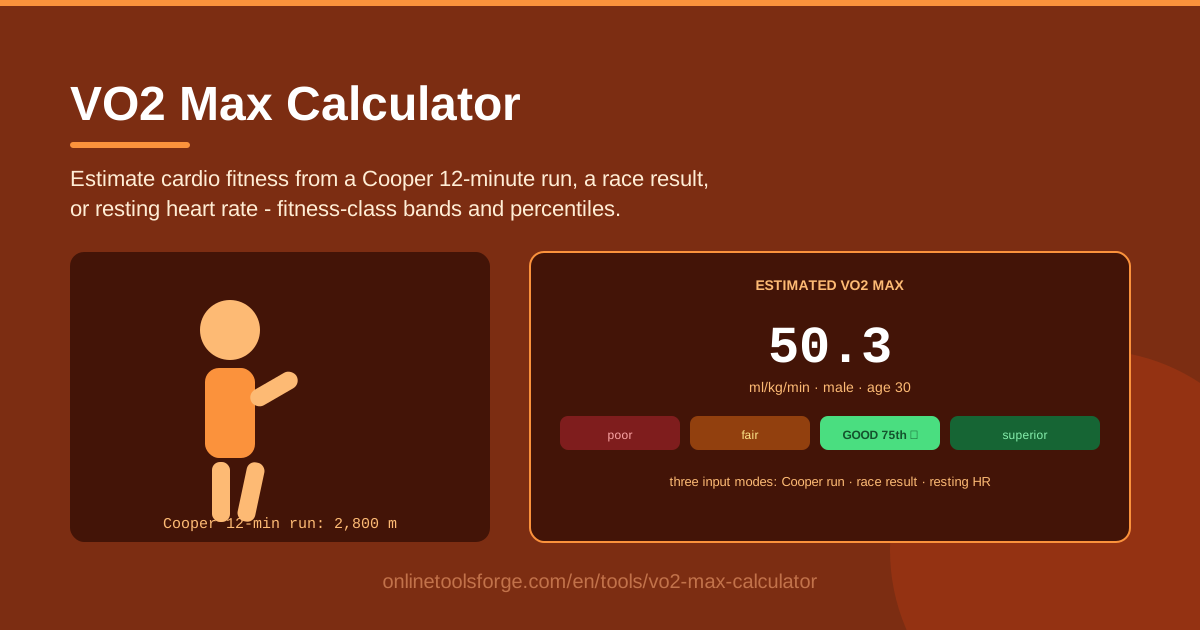
Table of Contents
VO2 max — the maximum volume of oxygen your body can take in and use per minute, scaled to every kilogram of body weight — is widely regarded as the single best snapshot of aerobic fitness. Coaches build training plans around it, and runners use it to check whether fitness is genuinely improving. The good news: you no longer need a physiology lab to get a useful number. The free VO2 Max Calculator estimates your score in ml/kg/min from three everyday inputs — a Cooper 12-minute run distance, a recent race result, or your resting heart rate — right in your browser.
Traditional VO2 max testing means a treadmill, a breathing mask, gas-exchange analyzers, and a run to exhaustion. Field estimates like the Cooper test were invented in the 1960s precisely because that setup is expensive and impractical. This calculator applies those long-established formulas instantly and adds the context raw numbers lack: sex-based fitness-class bands from poor to superior, plus a percentile estimate.
Why Use VO2 Max Calculator?
- No lab, no gear, no cost. A track, a watch, or even a recent race result is enough — the formulas run instantly in your browser.
- Three input modes. Choose a Cooper 12-minute run, a race result, or resting heart rate, depending on what you have available.
- Context, not just a number. Results come with fitness-class bands and a percentile, so the score actually means something.
- Sex-based bands. Men and women have different typical ranges, and the poor-to-superior classes reflect that reality.
- Private by design. Everything is computed locally on your device — no signup, no uploads, no data leaving your browser.
- Built for tracking. Retests every 6–8 weeks with the same formula reveal real trends.
Key Features
| Feature | What it does |
|---|---|
| Cooper 12-minute run mode | Converts your 12-minute distance into an estimated VO2 max in ml/kg/min |
| Race result mode | Estimates VO2 max from a recent finish time over a known distance, such as a 5K or 10K |
| Resting heart rate mode | Gives a rough cardio fitness estimate from your resting HR, no running required |
| Fitness-class bands | Places your score into sex-specific categories from poor to superior |
| Percentile estimate | Shows roughly how your score compares with the general population |
| Runs in the browser | Instant results with no downloads, accounts, or data collection |
- The ml/kg/min output matches the unit used by wearables and training platforms, so your estimate stays comparable across tools.
- Bands are sex-based because typical values differ by roughly 10–15% between men and women.
- Percentiles are context, not judgment — they tell you where you sit today, not where you can get to.
How to Use VO2 Max Calculator
- Pick your input mode. Open the calculator and choose between the Cooper 12-minute run, race result, or resting heart rate options.
- Run the Cooper test or enter a race. For the Cooper mode, warm up, then run as far as you can in exactly 12 minutes on a track and note the distance. For race mode, enter a recent finish time over a known distance.
- Read your estimated VO2 max. The result appears immediately in ml/kg/min, the standard unit for aerobic fitness.
- Find your class band. Check the sex-based fitness-class table to see whether you land in poor, below average, average, above average, good, or superior.
- Record and retest. Note the date, mode, and score, then retest in 6–8 weeks under similar conditions to track genuine change.
What VO2 Max Measures
Oxygen uptake per kilogram, explained. VO2 max is how much oxygen your body can consume at maximum effort, divided by body weight. Oxygen powers aerobic energy production, so a higher number means a bigger engine: stronger heart stroke volume, denser capillaries, and more mitochondria in muscle.
The Cooper 12-minute run protocol. Dr. Kenneth Cooper's field test asks you to cover the greatest distance possible in 12 minutes of continuous running. The formula uses your distance in meters because maximal sustainable pace over 12 minutes closely tracks aerobic capacity. Run on a 400-meter track and hold an even effort rather than sprinting early.
Race-result conversion intuition. A race time encodes the same physiology: the pace you can hold for roughly 5–20 minutes sits at or near the intensity your VO2 max supports. The calculator works backward from your speed to an equivalent oxygen uptake. Recent all-out efforts over 1.5–10 km give the tightest estimates.
Resting heart rate mode: know its limits. A lower resting HR usually signals a heart that pumps more blood per beat, and population formulas turn that into a rough fitness estimate. But resting HR also responds to stress, sleep, caffeine, and genetics, so treat this mode as a screening glance, not a training benchmark.
Fitness-class bands and percentiles. The bands split results into categories from poor to superior, calibrated separately for men and women. A score of 45 ml/kg/min is superior for a 55-year-old woman but merely average for a 25-year-old man. The percentile positions your score against the population so "good" means something concrete.
Lab test versus estimate: the honest reality. A lab test with gas analysis remains the gold standard, though even it varies with the day and your pacing. Field estimates typically land within about 5–10% of lab values — close enough for tracking trends, classifying fitness, and setting training zones.
Practical Use Cases
Tracking a running program
Start a 12-week 5K plan with a baseline Cooper test at 2,100 meters (roughly 44 ml/kg/min). Retest at week 6 and week 12 under the same conditions. Watching the number climb to 46, then 49, turns vague "I feel fitter" into evidence.
Pre-season fitness baseline
Team-sport athletes and coaches use a pre-season VO2 max number to set expectations. A soccer player at 52 ml/kg/min before training camp knows how much aerobic work the next eight weeks demand.
Comparing training blocks
Did your base-building block actually work? Compare a race-mode estimate from your spring 10K against a Cooper-mode estimate in the fall. Judge blocks by the direction and size of the change — three to five ml/kg/min is meaningful, not noise.
Longevity motivation
Research consistently links higher cardiorespiratory fitness with lower all-cause mortality risk. Watching your score move from below average to average is one of the most motivating, measurable signals that your heart health is heading in the right direction.
Best Practices
- Test on a track or known distance. GPS error of even 2% shifts your estimate; a 400-meter track removes the guesswork.
- Warm up properly. Ten easy minutes plus a few strides lets you run a true effort without shocking cold muscles.
- Use the same mode each time. Cooper, race, and resting-HR estimates disagree by design; comparing across modes compares apples to oranges.
- Pace evenly in the Cooper test. Going out too hard is the most common way to underperform; aim for the fastest sustainable, even effort.
- Retest every 6–8 weeks. Fitness changes slower than motivation, and more frequent testing mostly measures day-to-day noise.
- Judge trends, not single scores. Weather, fatigue, and estimation error make one number a snapshot; three numbers are a story.
Ready to put a number on your fitness? Run the VO2 Max Calculator today, log your baseline, and book your next retest six weeks out. It takes about a minute, costs nothing, and gives every future workout a benchmark to beat.
Related Tools You Might Like:
- BMI Calculator — VO2 max is weight-relative, so knowing your BMI adds useful context to your score.
- Macro Calculator — fuel your training with protein, carb, and fat targets matched to your goals.
- Interval Timer — build VO2 max with structured intervals, from short repeats to longer efforts.
Happy training!
Frequently Asked Questions
Q: How accurate is a VO2 max estimate compared to a lab test? A: Field estimates typically fall within about 5–10% of a gas-analysis lab test. That is not tight enough for research, but plenty accurate for tracking trends and setting training intensities.
Q: How often should I retest my VO2 max? A: Every 6–8 weeks under the same conditions — same mode, same track, similar time of day. Retesting more often mostly measures day-to-day noise rather than real fitness change.
Q: Can I use the resting heart rate mode instead of running a Cooper test? A: Yes, if you want a zero-effort screening estimate. It is the least precise of the three modes, since resting heart rate also responds to stress, sleep, caffeine, and genetics.
Q: What is a good VO2 max score? A: It depends on your sex, age, and training background. For many adult men, roughly 40–50 ml/kg/min is a solid range; for adult women, roughly 35–45. The calculator's sex-based class bands and percentile give you the exact context for your own number.