Exponential Backoff Calculator: Plan Retry Delays With Cap and Jitter
Free exponential backoff calculator. Compute retry delay schedules with base interval, multiplier, cap, and jitter (full, equal, or decorrelated), view a retry-by-retry timeline with cumulative wait, and copy ready-to-use Python/JS snippets. 100% client-side.
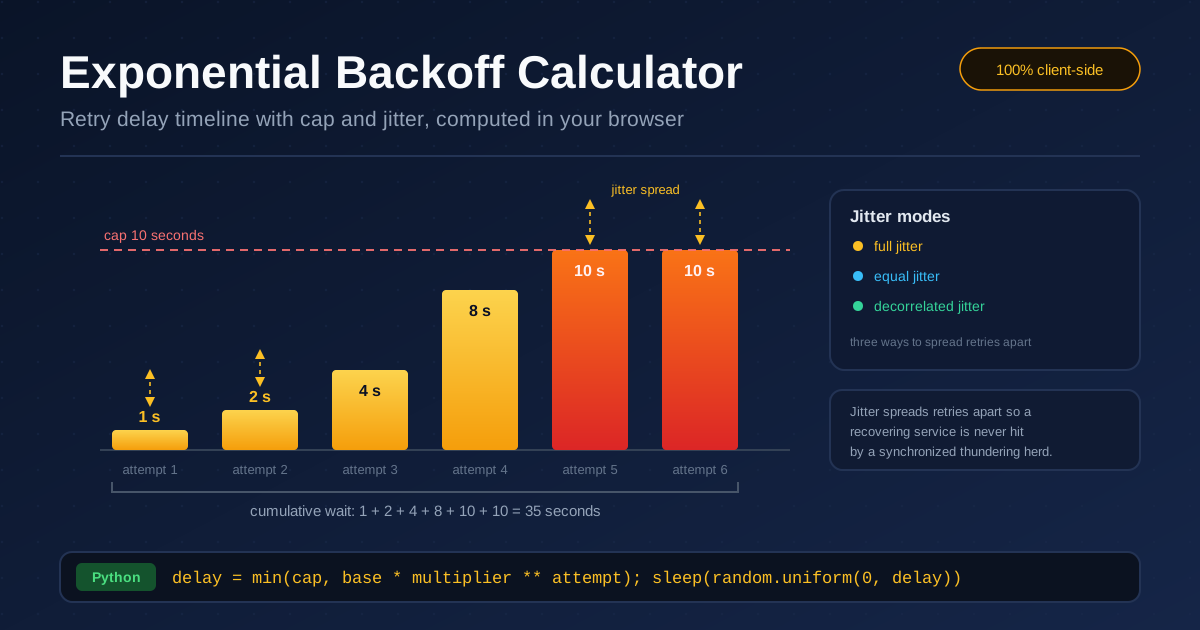
Table of Contents
Exponential Backoff Calculator: Plan Retry Delays With Cap and Jitter
Every network call eventually fails: a timeout, a 503, a dropped connection. The instinct after failure is to retry immediately — and that instinct is exactly how one overloaded server becomes a hundred angry clients, as every rejected caller fires again at the same instant against a system already on its knees. Exponential backoff is the fix: wait longer after each failure so load drains away while the service recovers.
The free exponential backoff calculator turns that principle into a concrete retry-by-retry timeline. Set a base interval, a multiplier, a maximum delay (the cap), and a jitter mode — full, equal, or decorrelated — and watch each wait and the cumulative total build up live. When the numbers look right, copy a ready-to-use Python or JavaScript snippet straight into your code.
Everything runs 100% client-side in your browser — no signup, no uploads, just the schedule you need before shipping the retry loop your uptime depends on.
Why Use Exponential Backoff Calculator?
- See the whole schedule before you ship it: every attempt appears with its delay and running cumulative wait, so surprises happen on screen instead of in your incident channel.
- Tune all four knobs at once: base interval, multiplier, cap, and jitter interact, and the timeline updates instantly so you can feel each trade-off.
- Plan against a timeout budget: six retries at 1, 2, 4, 8, 10, 10 seconds is 35 seconds of cumulative waiting — the calculator makes that forgotten total visible.
- Copy production-ready snippets: tuned parameters come back as clean Python or JavaScript, so the schedule you validated is the schedule your code runs.
- Instant and private: all computation happens locally, so you can iterate on internal parameters without sending them anywhere.
Key Features
| Feature | What It Does |
|---|---|
| Four delay inputs | Base interval, multiplier, cap, and jitter mode set the shape |
| Retry timeline | The wait before each retry plus the cumulative wait so far |
| Jitter modes | Full, equal, and decorrelated randomization of the waits |
| Code snippets | Copy-ready Python and JavaScript with your exact parameters |
| 100% client-side | Everything computes in the browser; nothing leaves your device |
- The timeline updates as you type, so a base or cap change is reflected on every attempt at once.
- Snippets reflect your current settings — tweak the cap and the copied code matches immediately.
How to Use
- Set the base interval. Open the exponential backoff calculator and enter the first wait, typically 0.5 to 2 seconds for interactive APIs.
- Choose the multiplier. Two is the common default: each wait doubles, turning 1 second into 2, then 4, then 8.
- Set the cap. Pick the maximum delay any single wait may reach — this stops runaway growth and defines the plateau.
- Pick a jitter mode. Choose full, equal, or decorrelated jitter to randomize waits and stop clients retrying in lockstep.
- Read the timeline, then copy the snippet. Check each delay and the cumulative total against your budget, then copy the snippet into your client.
Base, Multiplier, Cap, Jitter
The raw delay for attempt n is base × multiplier^n, clamped by the cap:
delay = min(cap, base * multiplier ** attempt)
The base sets the pace of early retries: short for transient blips, slower when failures mean real congestion. The multiplier controls how fast the schedule backs away. Two is the classic choice — doubling keeps the numbers readable. Push it to 3 and you yield the road faster but leave dead zones; drop it to 1.5 and you spend budget early.
The cap is the safety rail. Without one, a multiplier of 2 across twelve retries ends in a wait of over an hour. Once base × multiplier^n exceeds the cap, every later wait is the cap and the curve plateaus. Roughly 8 to 32 times your base is a sensible starting point, matched to how long an outage plausibly lasts.
Jitter exists because of the thundering herd problem. If a thousand clients fail together against a recovering service, deterministic backoff means they fail together again — synchronized retries re-overload the service in waves when it can least absorb them. Jitter randomizes each wait so the herd spreads out.
| Jitter mode | How the wait is chosen | Best for |
|---|---|---|
| Full | Uniform random from 0 up to the computed delay | Simplest and most effective spreading |
| Equal | Random between half and the full computed delay | Keeping waits close to the plan |
| Decorrelated | Random between base and triple the previous wait | Heavy, continuous traffic patterns |
Full jitter is the usual recommendation: widest spread, simplest formula, at the cost of occasionally retrying almost immediately. Equal jitter keeps a floor of half the planned delay. Decorrelated jitter anchors each wait to the previous one, avoiding rhythmic load in high-volume traffic.
Cumulative wait is where plans meet reality: add up the waits across your allowed retries and compare the total to your timeout budget. A path that gives users ten seconds cannot afford six retries with a 35-second cumulative wait. Fewer retries with a higher cap suit background jobs; more retries with a small cap suit interactive calls.
A worked timeline — base 1 second, multiplier 2, cap 10 seconds, six attempts — gives a raw schedule of 1, 2, 4, 8, then 10 and 10 at the cap: 35 seconds cumulative. With full jitter, each wait is a uniform random value from 0 up to that raw amount, so capped attempts land anywhere in 0 to 10 seconds. A single run looks irregular, but across many clients the synchronized spikes vanish.
Practical Use Cases
API client libraries
Wrappers around rate-limited or occasionally flaky APIs are the classic home for backoff. Compute the schedule once, ship it in the client, and every consumer gets sane 429 and 503 handling for free.
Webhook redelivery
When your platform promises to redeliver failed webhooks, the delivery schedule is a product decision. A capped, jittered schedule lets receivers recover without your queue growing unbounded.
Job queue retry policies
Background workers live and die by their retry policy. A visible timeline lets you state it precisely — "five attempts, exponential, 30-second cap, full jitter" — and verify the worst-case delay a failed job introduces.
IoT message sends
Battery-powered devices cannot afford retry loops that drain the radio. A long base and generous cap stretch the schedule, while jitter keeps devices from re-syncing after a gateway blips.
Best Practices
- Always add jitter. Deterministic backoff still fails in herds; randomization is what de-synchronizes callers.
- Always set a cap. Uncapped exponential growth turns a timeout policy into a sleeping-thread generator.
- Retry only idempotent operations. If repeating the request can double a charge, backoff is not your problem — idempotency keys are.
- Stop after a budget, not a hope. Decide the maximum retries and cumulative wait up front, then give up cleanly.
- Honor Retry-After headers. When the server says how long to wait, that overrides any computed schedule.
- Separate retryable from fatal errors. A 500 deserves patience; a 400 validation error fails identically on every attempt.
Give Every Retry Room to Breathe
Retries are insurance: you trade a little latency for a lot of resilience, but only if the schedule is sane. Open the exponential backoff calculator, dial in your base, multiplier, cap, and jitter, and copy the snippet into your next client or worker.
Related Tools You Might Like:
- 555 Timer Calculator — the same timing discipline, applied to astable and monostable circuits instead of retries.
- JSON Formatter — inspect the error payloads your retries are reacting to.
- Date Range Splitter — slice long monitoring windows into even chunks when analyzing retry behavior.
Happy retrying!
Frequently Asked Questions
Q: What is exponential backoff in simple terms?
A: A retry strategy where each wait grows by a fixed multiplier — commonly doubling — after every failure, so 1 second becomes 2, then 4, then 8. The growing gaps give a struggling server time to recover, and a cap keeps waits bounded.
Q: Why is jitter necessary if backoff already spaces retries out?
A: Deterministic backoff spaces out each caller's retries, but callers that failed together stay synchronized together. Jitter randomizes the waits so the crowd spreads across the schedule; without it, a recovering service is hit by the same thundering herd wave after wave.
Q: How do I choose the cap and the number of retries?
A: Work backwards from your timeout budget. Keep the cumulative wait across all attempts inside the time your caller accepts, then set the cap so the schedule plateaus inside that envelope.
Q: Does the calculator upload my parameters anywhere?
A: No. All computation runs client-side in your browser. Nothing is sent to a server, nothing is stored, and the tool keeps working offline once loaded.