Headline Analyzer: Score Your Titles 0-100 Before You Publish
Free headline analyzer that scores any title for SEO length, power words, and sentiment with an instant 0-100 verdict. Offline word banks, fully in your browser.
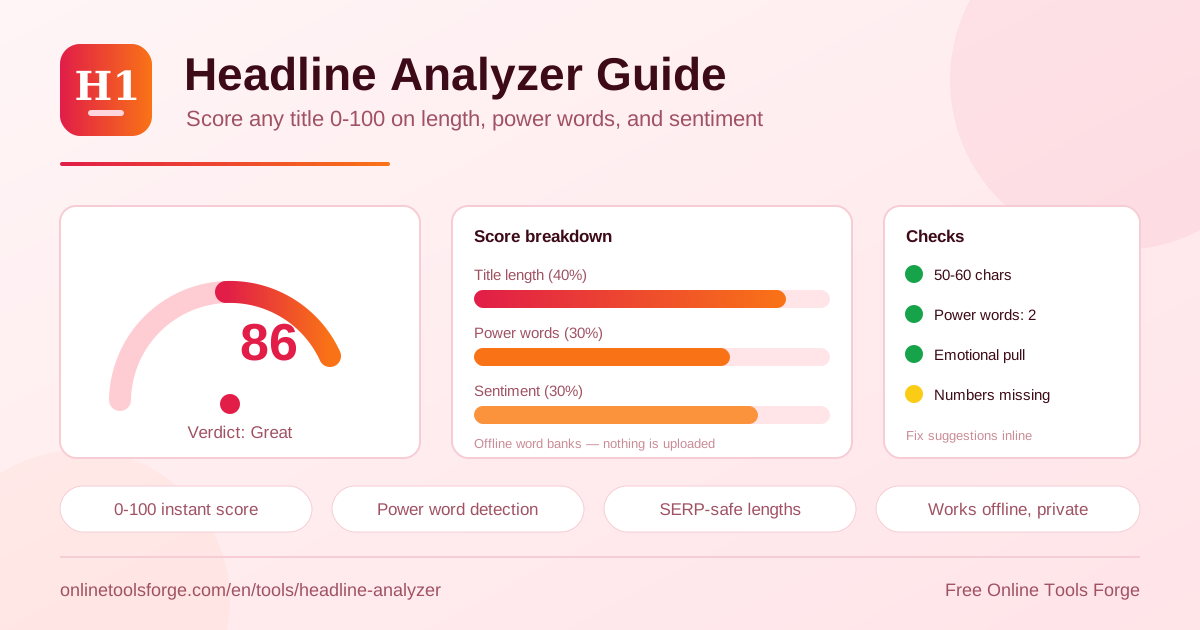
Table of Contents
Your headline does more work than any other line you write. It competes on a crowded search results page, in a busy inbox, or inside an endless video feed, and it has roughly one second to earn a click. A brilliant article behind a weak title almost always loses to an average article behind a strong one.
That is exactly why we built the free headline analyzer. Paste any title and get an instant 0-100 score built on three proven copywriting signals: SEO-safe title length, the presence of power words, and emotional sentiment. Everything runs in your browser with bundled offline word banks — no signup, no uploads, and your headlines never leave your device.
This guide explains how the score is calculated, what each signal measures, and how to use the tool to sharpen blog titles, email subject lines, video titles, and ad copy before you publish.
Why Use the Headline Analyzer?
- Instant, objective feedback. Instead of debating titles in your head, paste them in and get a numeric score and verdict in milliseconds.
- SERP-safe length checking. Good SEO titles land in a specific character range; the tool flags titles too short to be descriptive or too long to display fully in Google.
- Power word detection. The analyzer matches your headline against a bundled power-word bank and rewards words known to lift click-through rates.
- Sentiment scoring. Emotional pull sells. Positive and negative word banks measure whether your title carries feeling or reads flat.
- Completely private. Every word bank ships with the page and every calculation happens locally, so sensitive drafts stay on your machine.
- Free with no account. Open the page, paste, score — no signup, no limits.
Key Features
| Feature | What it does |
|---|---|
| 0-100 headline score | Blends length, power words, and sentiment into one instant verdict |
| Title length check | Scores your headline against the SERP-safe character range |
| Power word analysis | Counts matches from the bundled power-word bank |
| Sentiment analysis | Weighs positive and negative words to gauge emotional pull |
| Verdict labels | Maps your score to a label from Poor up to Great (80+ is Great) |
| Live scoring | Results update instantly as you type or paste |
A few details worth knowing:
- The length engine counts characters, not words, because search engines and social platforms truncate by character count.
- The power-word and sentiment banks are bundled with the page, so the tool works offline and stays instant even on slow connections.
- The verdict label gives a plain-language answer at a glance: if it says Great, publish with confidence.
How to Score a Headline
- Open the headline analyzer in your browser.
- Paste or type your headline into the input field.
- Read your instant 0-100 score and its verdict label, from Poor to Great.
- Inspect the breakdown of title length, power words, and sentiment to see which signal is holding the score back.
- Rewrite the weak part, paste the new version, and repeat until you reach 80 or higher.
How the 0-100 Score Works
The final score is a weighted blend of three independent signals:
score = 40% × length score
      + 30% × power word score
      + 30% × sentiment score
Title length carries 40%. Search engines typically display about 50-60 characters of a title tag before truncating it with an ellipsis. Titles inside that range deliver their full promise to searchers; titles that are too short usually lack the keywords and detail that make a result compelling, while titles that are too long get cut off mid-sentence. Length gets the largest weight because truncation can erase everything else you did well.
Power words carry 30%. Power words are terms with a track record of driving clicks — words like proven, essential, instant, free, or surprising. The analyzer scans your headline against its bundled power-word bank and scores how much persuasive vocabulary you have worked in. One or two well-placed power words lift a title noticeably; stuffing in five makes it read like spam, so the signal rewards presence rather than saturation.
Sentiment carries 30%. Headlines that make readers feel something get clicked more than headlines that merely inform. The tool scores your title against positive and negative word banks to measure emotional charge. A flat, purely descriptive title scores low here even if it is perfectly formatted — adding a word like effortless or avoid gives the score, and your click-through rate, a real nudge.
Verdict bands. The raw score maps to a plain-language verdict, from Poor at the bottom through the middle grades up to Great. A score of 80 or above is Great: safe length, genuine persuasive pull, and emotional charge, ready to publish. Mid-range scores usually mean exactly one component is dragging, and the breakdown tells you which one to fix first.
Practical Use Cases
Blog Post Titles
Blog headlines fight for space in search results, so length discipline matters most. A 70-character title like A Very Long and Thorough Guide to Everything You Could Possibly Know About Baking Bread will be truncated; trimming it to How to Bake Bread at Home: A Proven Beginner's Guide keeps the promise whole, adds a power word, and scores dramatically higher. Run every draft through the analyzer before it enters your CMS.
Email Subject Lines
Inboxes are brutal: most subject lines get cut off on mobile well before 60 characters. Use the analyzer as a subject line tester — paste each candidate and keep only the ones with safe length and strong emotional pull. Adding a power word like exclusive or urgent to an otherwise flat subject often moves the score, and your open rate, by a visible margin.
YouTube and Video Titles
Video titles blend SEO with pure click appeal, since viewers scan a wall of thumbnails. A title such as My Video About Productivity scores poorly on both power words and sentiment; The Surprising Productivity Trick That Saved My Mornings earns its Great verdict with a power word and genuine emotional charge. Test three or four variants and pick the highest score.
Ad and Landing Page Copy
Headline-style copy appears in ads, hero sections, and banners, where every character competes. Run candidate headlines through the analyzer to confirm they stay within display limits while still carrying emotional weight. The score gives your team a fast, shared benchmark for choosing between variants without another round of subjective debate.
Best Practices
- Aim for the 50-60 character sweet spot so full titles display in search results without truncation.
- Use one or two power words, not five — persuasive vocabulary works best when it feels natural.
- Front-load your keyword so it survives truncation on small screens and in social cards.
- Write three to five variants and score each one, then pick the winner instead of settling for your first draft.
- Match the emotion to the content — sentiment should reflect what the reader actually gets, or you will lose trust.
- Re-score after every edit — a single word change can move a title from Good to Great.
Score Your Next Headline Before You Publish
You already spent hours on the content; spend thirty seconds on the line that decides whether anyone reads it. Open the free headline analyzer, paste your title, and watch the 0-100 verdict appear instantly. No signup, no uploads — just a stronger headline before you hit publish.
Related Tools You Might Like:
- Readability Checker — make sure the body reads as smoothly as the title sells.
- Title Case Converter — format your polished headline with correct title case.
- Word Counter — track length and density for the full piece, not just the headline.
Happy writing!
Frequently Asked Questions
Q: Is the headline analyzer free to use?
A: Yes, completely. There is no signup, no usage limit, and no paid tier — open the page and score as many headlines as you like.
Q: Are my headlines uploaded to a server?
A: No. The tool uses bundled offline word banks and all scoring runs in your browser, so your drafts never leave your device.
Q: What score should I aim for?
A: Target 80 or above, which earns the Great verdict. Mid-range scores are usually publishable but have one weak signal — length, power words, or sentiment — worth improving first.
Q: Can I use it for YouTube titles and email subject lines?
A: Absolutely. The same scoring applies to any headline-style text, though email clients and mobile apps often truncate at fewer characters than Google does.
Q: Does a high score guarantee more clicks?
A: No tool can guarantee clicks — the score measures proven signals like length, power words, and sentiment. It greatly improves your odds and beats guessing every time.