JSON to Swift Converter: Generate Codable Structs from Any JSON Sample
Turn any JSON payload into clean Swift Codable structs with nested types, optionals, and configurable naming using the free JSON to Swift Converter — 100% in your browser.
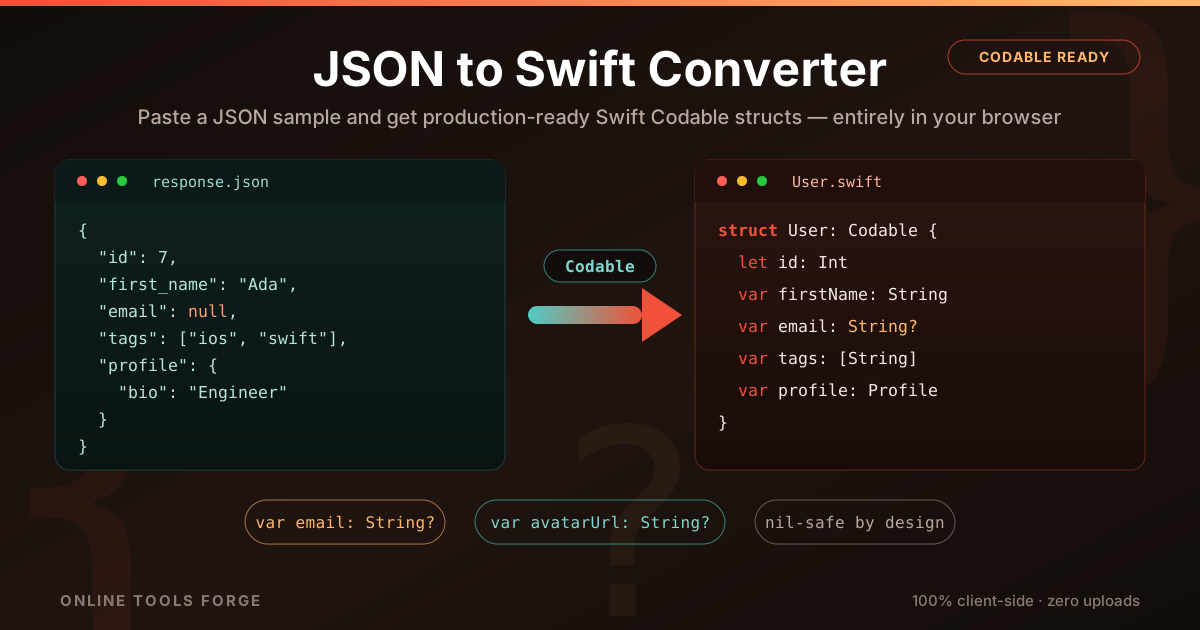
Table of Contents
JSON to Swift Converter: Generate Codable Structs from Any JSON Sample
Modern iOS apps live on JSON: every REST endpoint, Firebase document, and third-party API speaks it, and the standard bridge to your Swift code is the Codable protocol. Writing model structs by hand is tedious and error-prone — one typo in a property name means JSONDecoder quietly fails at runtime.
The JSON to Swift Converter removes that busywork. Paste any JSON sample and get clean Swift structs with Codable conformance, nested types expanded into their own structs, and optionals wherever a field is absent or null. Naming is configurable, so wire keys can stay snake_case while your properties read as idiomatic camelCase. Everything runs 100% client-side — your payloads never touch a server.
This guide covers why generated models beat hand-typed ones, how to use the converter, and how Codable behaves under the hood — including the gotcha that trips up nearly every developer once.
Why Use the JSON to Swift Converter?
- Skip the hand-typing, keep the correctness. Transcribing a 40-field response by hand invites misspelled properties and wrong types — generating from the actual payload guarantees the shape matches what the server sends.
- Optionals come from evidence, not guesses. A field missing from the sample — or present as null — becomes Type?, exactly the signal Codable needs, at every nesting level.
- Nested types stop being a chore. Objects inside objects become chains of small structs, each with its own conformance — twenty minutes of manual modeling appears in seconds.
- Configurable naming keeps your code idiomatic. Pick casing conventions for properties and types so the output drops in without a renaming pass; the JSON Formatter can normalize messy samples first.
- Private by architecture. Conversion runs entirely in your browser: production payloads and user records are never uploaded, logged, or stored.
- Free and instant. No account, no install, no Xcode round-trip — open a tab, paste, copy, move on.
Key Features
| Feature | What It Does |
|---|---|
| Codable conformance | Every generated struct declares Codable, ready for JSONDecoder and JSONEncoder out of the box. |
| Nested type support | Objects within objects become their own structs, wired through property types. |
| Optional properties | Fields absent or null in the sample are emitted as Type?. |
| Configurable naming | Choose the naming convention for properties and types to match your style guide. |
| 100% client-side | All parsing and code generation happen in the browser; nothing leaves your machine. |
- Faithful structure. Arrays of objects become arrays of the corresponding struct, not looser dictionary types.
- Zero dependencies. The result is plain Swift that compiles for iOS, macOS, watchOS, tvOS, and visionOS alike.
How to Use the JSON to Swift Converter
Step 1 — Open the Converter
Navigate to the JSON to Swift Converter — JSON input on one side, generated Swift on the other.
Step 2 — Paste Your JSON Sample
Paste any valid JSON object or array — a captured API response, a backend body, or a fixture file. If the sample is minified, tidy it up with the JSON Formatter first.
Step 3 — Choose Your Naming Style
Select the naming convention for generated properties and types — wire keys stay untouched while your Swift side stays idiomatic.
Step 4 — Review the Generated Structs
Check the output: fields missing or set to null appear as optionals, nested objects become their own structs, and arrays map to Swift arrays of those structs.
Step 5 — Copy into Xcode
Copy the code into a new file, build, and start decoding. Drop the original payload into a unit test so JSONDecoder confirms the model immediately.
Codable Without the Guesswork
A conforming type can be decoded from and encoded to JSON, with that machinery synthesized by the compiler from the stored properties. Nothing magic hides in the generated code — you can read it, modify it, and own it.
Take this API payload:
{
  "id": 7,
  "first_name": "Ada",
  "email": null,
  "tags": ["ios", "swift"],
  "profile": {
    "bio": "Engineer",
    "website": null
  }
}
The JSON to Swift Converter turns it into:
struct User: Codable {
    let id: Int
    var firstName: String
    var email: String?
    var tags: [String]
    var profile: Profile
}

struct Profile: Codable {
    var bio: String?
    var website: String?
}
Three things stand out. Structs and conformance: User and the nested Profile declare Codable, so the compiler generates the decoding logic — no handwritten init(from:) required. Optionals: email and website are null, so they are emitted as String?; an optional tolerates both a null value and a missing key, while a non-optional tolerates neither. Arrays: tags decodes into [String], and object arrays decode into struct arrays.
Because wire keys are snake_case while properties are camelCase, production code needs a CodingKeys enum — repetitive mapping work that generators never get wrong:
extension User {
    enum CodingKeys: String, CodingKey {
        case id
        case firstName = "first_name"
        case email
        case tags
        case profile
    }
}
Now the gotcha every Swift developer meets eventually: a missing non-optional field throws. If the server omits id, JSONDecoder raises keyNotFound and the whole decode fails, even though most of the object arrived fine. That is deliberate: Codable refuses to invent defaults you never specified. So fields the API might omit or null out should be optionals — which the converter marks automatically — while must-exist fields stay non-optional so malformed payloads fail loudly in development. Convert a few real payloads and compare: disagreements tell you which fields are unreliable.
Practical Use Cases
iOS networking layers
The classic fit. Generate one struct per endpoint response and drop them into a Models folder beside your networking code. When the backend ships a new field, reconvert a fresh capture and diff — the review takes minutes, not an afternoon.
watchOS and widget extensions sharing models
The same structs can live in a shared framework used by your iOS app, its watchOS companion, and home-screen widgets — one conversion feeds every target with no dependency to reconcile.
App Store server payloads
App Store Server API notifications and signed transactions are deeply nested, snake_case-keyed, and reshaped across versions. Converting a real notification into structs — with CodingKeys handled for you — beats modeling the hierarchy from documentation alone.
Prototype-to-production models
During a hackathon or spike, generate structs from live payloads and ship the same day. When the prototype graduates, the models already exist, already decode real data, and carry no framework baggage — refactor freely.
Best Practices
- Mark truly optional fields optional. If a field is sometimes absent in production, insist on Type? rather than papering over decode failures with defaults — feed it representative payloads.
- Add CodingKeys whenever casing differs. Never rename wire keys in your model and hope; map them explicitly so decoding stays deterministic.
- Decode with real payloads in unit tests. Keep captured responses as fixtures and assert decoding succeeds — this catches schema drift long before a crash report does.
- Regenerate on API change. Treat the output as the new baseline whenever the endpoint evolves, then diff it against your committed models instead of editing by memory.
- Validate samples before converting. A truncated paste produces misleading structs; a quick pass through the JSON Formatter confirms the sample is well-formed first.
- Keep one source of truth per platform. Pair this tool with the JSON to Kotlin Converter so iOS and Android models come from the same payload and cannot drift apart.
Start Converting JSON to Swift Today
Codable made JSON handling in Swift dramatically better, but it never solved the typing. The JSON to Swift Converter closes that gap: paste a payload and get correct structs with optionals, nested types, and project-matching naming — privately, instantly, entirely in your browser.
Related Tools You Might Like:
- JSON Formatter — validate, pretty-print, and normalize JSON samples before converting
- JSON to Kotlin Converter — the same generate-from-payload workflow for Android data classes
- OpenAPI to TypeScript Converter — turn full API specifications into typed models for your web stack
Happy decoding!
Frequently Asked Questions
Q: Is my JSON sent to a server when I convert it?
A: No. Parsing and code generation happen locally in your browser; nothing is uploaded, stored, or logged.
Q: How does the tool decide which properties become optionals?
A: Any field absent from your sample or present as null is emitted as Type?; fields with concrete values become non-optional. Feed it a payload reflecting real API behavior, including fields that sometimes disappear.
Q: Can it handle deeply nested JSON with arrays of objects?
A: Yes. Nested objects become their own structs and arrays of objects become Swift arrays of the corresponding struct, at any depth — each with its own Codable conformance.