Moon Phase Calculator: Find the Lunar Phase for Any Date
Free moon phase calculator guide. Get illumination percent, moon age, Moon-Earth distance, and exact times of the next new moon, first quarter, full moon, and last quarter — computed offline in your browser.
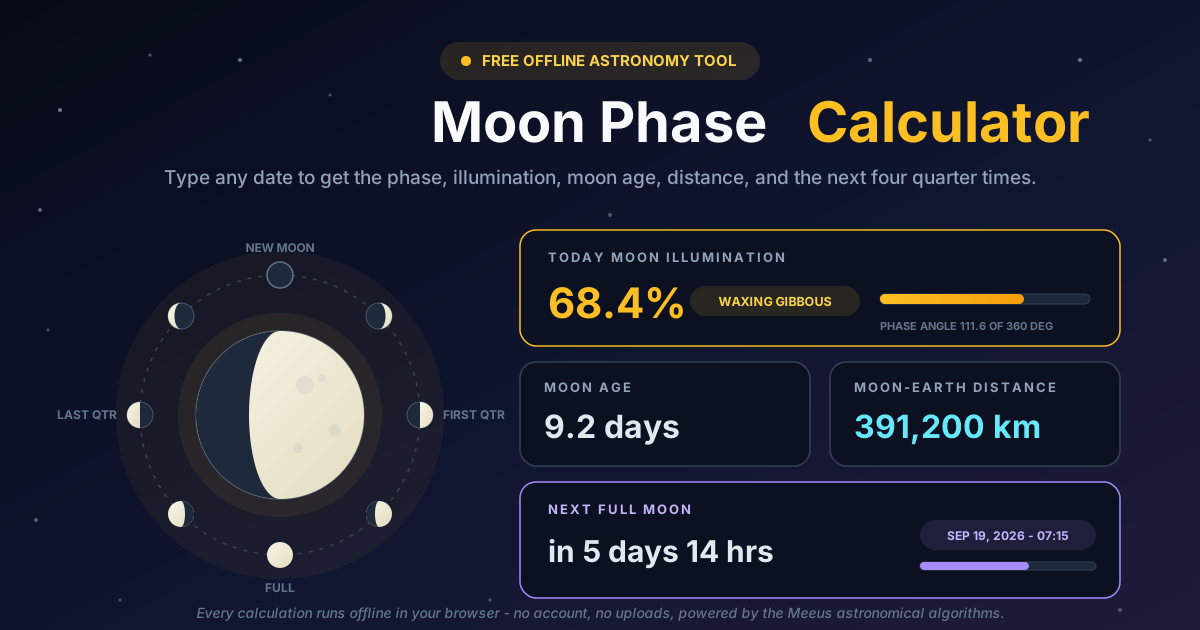
Table of Contents
Moon Phase Calculator: Find the Lunar Phase for Any Date
The Moon is the most predictable object in the night sky, yet most of us can only glance up and guess: is that gibbous waxing or waning, and how dark will the sky be on your camping night? The Moon Phase Calculator answers it all: pick any date — past or future — and get the precise phase, illumination percent, the Moon's age in days, its distance from Earth, and the exact times of the next new moon, first quarter, full moon, and last quarter.
Most moon-phase websites call an external API or embed a rough lookup table. This tool does neither: it runs the classical astronomical mathematics of Jean Meeus's Astronomical Algorithms directly in your browser, fully offline. Load it once and it keeps working on a plane or a trailhead, exactly where moon questions come up.
Why Use Moon Phase Calculator?
- Any date, not just today. A birthday twenty years ago, a wedding next spring, an eclipse in 2028 — the same instant computation covers any date.
- More than a phase icon. You get a continuous phase angle, illumination percent, moon age, and Moon–Earth distance — numbers you can actually plan with.
- Exact times for the next four milestones. Not "around the 15th," but the specific date and time the Moon reaches new, first quarter, full, and last quarter.
- 100% offline and private. Everything is computed in your browser; nothing is uploaded or logged, and the page works without a connection.
- Grounded in real astronomy. The formulas come from Meeus's Astronomical Algorithms, far closer to true ephemeris data than "divide the month by four" approximations.
- Free with no signup. Open the page, pick a date, read the answer.
Key Features
| Feature | What it does |
|---|---|
| Any-date lookup | Computes the lunar phase for any calendar date, past or future |
| Continuous phase angle | Reports 0–360 degrees from new moon, not one of eight buckets |
| Illumination percent | Shows the lit fraction of the disk to a tenth of a percent |
| Moon age in days | Converts the phase angle into days since the last new moon |
| Moon–Earth distance | Estimates current distance in km from the main periodic terms |
| Next quarter times | Exact upcoming new moon, first quarter, full moon, last quarter |
| 100% offline | Every calculation runs locally — no API calls, no tracking |
The continuous phase angle makes everything precise: the tool reports exactly where the Moon sits between the eight named boxes. Next-quarter times come from scanning the Moon's motion forward and narrowing each crossing — a search that finishes in milliseconds.
How to Use
- Open the Moon Phase Calculator in your browser.
- Pick a date — it defaults to today, and any past or future date works the same way.
- Read the phase dial, which names the current phase and draws the lit fraction.
- Check the readouts: illumination percent, moon age in days, and Moon–Earth distance in kilometers.
- Scroll to the next-phase panel for the exact upcoming new moon, first quarter, full moon, and last quarter times — change the date and everything recalculates instantly.
No account, no configuration, no waiting.
The 29.5-Day Lunar Cycle, Explained
The Moon takes 29.53 days on average to return to the same phase — the synodic month, and the reason "moon month" and calendar month slowly drift apart.
The four quarters and their phase angles
Astronomy measures phase as an angle from new moon: 0 degrees is new moon, 90 first quarter, 180 full, and 270 last quarter. The familiar eight names fill the gaps: waxing crescent between 0 and 90, waxing gibbous between 90 and 180, and their waning mirrors. Because the angle is continuous, the tool can say the Moon sits at 111 degrees — two-thirds of the way from first quarter to full.
Illumination percent versus moon age
Moon age is the phase angle converted to days: 360 degrees over 29.53 days, so a first-quarter Moon is about 7.4 days old. Illumination is the lit fraction, and it moves nonlinearly — creeping after new moon, rushing through 50 percent near the quarters, then slowing toward full. Photographers and dark-sky planners should watch the percentage, not the age.
Why the Moon–Earth distance changes
The lunar orbit is an ellipse, so distance swings between roughly 356,500 km at perigee and 406,700 km at apogee — about 11 percent. A full moon near perigee looks larger and brighter — the press calls it a supermoon — while near apogee it is the ignored micromoon. The distance readout tells you which kind of full moon you are getting.
What the Meeus algorithm actually does
In plain words: your date becomes a Julian day, astronomy's continuous day counter. The Moon's mean position is then corrected with periodic terms — adjustments for the gravitational tugs that make real orbits lumpy — yielding the Sun–Moon elongation that becomes your phase angle and illumination. To find quarter times, the tool steps the phase forward, detects each crossing of 0, 90, 180, or 270 degrees, and narrows in on the exact moment.
Moon lore that still holds up
Anglers favor the days around new and full moons, when spring tides run strongest — solunar feeding theory is unproven, but the tide link is real. Photographers know quarter-moon light sculpts craters beautifully, while a full moon looks flat up close. And in Thailand the lunar calendar still shapes daily life: wan phra observance days fall at the quarters and full moon of each fortnight, and holidays like Makha Bucha, Visakha Bucha, and Loy Krathong all ride this same 29.5-day cycle.
Practical Use Cases
Astrophotography and stargazing planning
Deep-sky shooters live by the new moon: near-zero illumination means dark skies for nebulae and galaxies. Lunar photographers want the opposite — quarter-moon nights, when terminator shadows make craters pop.
Fishing, tides, and gardening traditions
Spring tides — the biggest tidal swings — follow new and full moons within a day or so, giving anglers and boaters a tide-strength proxy. Gardeners who follow traditional lunar scheduling can scan whole seasons at once.
Events, festivals, and night outings
Night hikes, full-moon paddles, and lantern festivals all orbit the same calendar. Rangers scheduling moonlight walks and families planning Loy Krathong evenings can pin dates to the exact full moon rather than folklore.
Best Practices
- Allow a small prediction margin. The main terms of the Meeus series are excellent but simplified; treat quarter times as accurate to a minute or two.
- Be timezone-aware. Times use your device's timezone, so a full moon at 23:58 for you may fall "the next night" elsewhere.
- Check moonrise and moonset separately. A phase says how much of the Moon is lit, not whether it is up — pair the tool with a Sunrise Sunset Calculator.
- Remember that full looks full for days. At 98 percent illumination the Moon already appears complete, so for a bright night any evening near full will do.
- Use illumination, not age, for light-sensitive plans. Stargazers care how much light the Moon adds to the sky, and the percentage answers that directly.
- Mind your hemisphere. The waxing Moon is drawn lit on the right, the northern-hemisphere view; southern latitudes see the lit side flipped.
Put the Moon on Your Schedule
The Moon keeps perfect time whether anyone checks or not — but once you can check, every dark-sky window, spring tide, and moonlit evening becomes plannable instead of lucky. Open the Moon Phase Calculator, enter your next big night, and see what the sky has scheduled.
Related Tools You Might Like:
- Sunrise Sunset Calculator — pair moon phases with exact golden hour, blue hour, and twilight times
- Sleep Cycle Calculator — plan bedtimes around late-night observing or pre-dawn fishing sessions
- Zodiac Sign Calculator — explore the astrological side of any lunar date
Clear skies and happy moongazing!
Frequently Asked Questions
Q: How accurate are the moon phase predictions? A: The illumination and phase angle are essentially exact for everyday use, and quarter times are typically within a minute or two of observatory ephemeris data — far better than calendar approximations.
Q: Does the calculator need an internet connection? A: No. Once the page is loaded, every computation runs locally in your browser, with no API calls and no data leaving your device.
Q: What is the difference between illumination percent and moon age? A: Moon age counts days since the last new moon at a constant rate; illumination measures the lit fraction, which changes fastest around the quarter moons. A Moon 50 percent lit is near a quarter phase, not halfway to full.
Q: Is the moon phase the same everywhere on Earth? A: Yes — phase comes from the Sun–Moon–Earth geometry, so everyone sees the same phase at the same instant. What differs by location is when the Moon rises, sets, and how high it climbs.