Solar Panel Calculator: Know the Array Size Your Home Actually Needs
Free solar panel calculator that sizes a rooftop PV system from monthly kWh, peak sun hours, and panel wattage — array size, panel count, roof area, and string config, all offline in your browser.
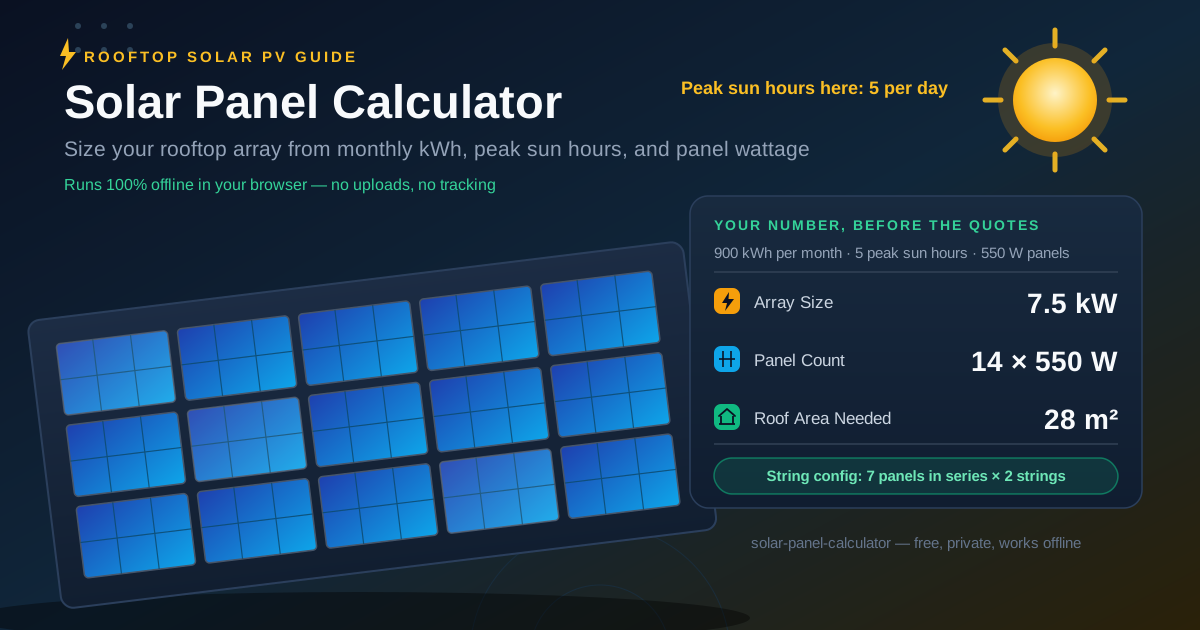
Table of Contents
Solar Panel Calculator: Know the Array Size Your Home Actually Needs
Ask three solar installers for a quote and you will often get three different system sizes at three different prices. Before any quote, know your own number: the array size your usage actually needs. The Solar Panel Calculator turns three inputs from your bills into that number in seconds, so quotes can be compared, not trusted.
Enter your monthly kWh usage, the peak sun hours where you live, and the panel wattage you are considering; the tool derives array size in kW, panel count, roof area, and a practical string configuration. Everything runs 100% offline in your browser — no sign-up, no data leaves your device.
Why Use Solar Panel Calculator?
- An independent sizing sanity check. Installers size around their lineup and margin. Knowing 900 kWh per month needs roughly 7.5 kW forces oversized proposals to defend themselves.
- 100% offline and private. Everything runs in your browser; consumption data never touches a server, and it works even on a metered connection.
- String configuration for installer conversations. It shows how panels group into series strings per MPPT input, so you can follow and question the proposed layout.
- Roof area feasibility early. A 10 kW array sounds great until you measure the roof — the approximate area needed tells you whether it fits.
- Instant what-if comparisons. Raise panel wattage and watch panel count and roof area drop; shift sun hours and watch array size swing.
- Transparent math. Every formula is documented below — verifiable with a napkin and a pencil, as a planning number should be.
Key Features
| Feature | What it does |
|---|---|
| Monthly kWh input | Straight from your electricity bill. |
| Peak sun hours input | Daily peak sun hours for your location. |
| Panel wattage input | Typically 400–550 W. |
| Array size output | System size in kW your usage requires. |
| Panel count output | Panels needed, rounded up. |
| Roof area output | Area needed, including panel spacing. |
| String configuration | Series-string layout per MPPT input. |
- A system efficiency factor of ~0.8 is built in, covering inverter losses, wiring, soiling, and imperfect orientation.
- Results update as you type, making it easy to bracket scenarios — a low-sun winter month against an annual average.
How to Use
- Enter your monthly kWh usage. Take it from your latest bill; if usage swings by season, run it for your average and highest months.
- Enter your local peak sun hours. Roughly 4.5–5 in Thailand, 2.5–3 in Germany, about 6 in Arizona; discount regional figures for shaded roofs.
- Pick your panel wattage. Modern residential panels run 400–550 W; higher wattage means fewer panels and less roof area per kW.
- Read the array size and panel count. Array size is your headline number for comparing quotes; panel count shows the units on your roof.
- Check the roof area and string layout. Compare against your usable roof and note the suggested string configuration before meeting an installer.
From Bills to Array Size
Here is the full calculation as a worked example: 900 kWh per month, 5 peak sun hours, 550 W panels.
Step 1: convert monthly usage to daily. Utilities bill monthly; the sun delivers daily.
Daily kWh = monthly kWh ÷ 30
900 ÷ 30 = 30 kWh per day.
Step 2: convert daily energy into array size. Panels only produce rated power under ideal conditions; inverter losses, wiring, soiling, and heat shave roughly another 20%, so planning divides by a system efficiency of about 0.8:
Array kW = daily kWh ÷ (peak sun hours × 0.8)
30 ÷ (5 × 0.8) = 30 ÷ 4 = 7.5 kW.
A note on peak sun hours. Peak sun hours are not daylight hours — they are equivalent hours per day of full-strength sun (1,000 W per square metre). A place can have 12 hours of daylight but only 4 peak sun hours. That is why Thailand (~4.5–5) out-produces Germany (~2.5–3), while Arizona (~6) needs a smaller array. Using daylight hours undersizes a system by more than half.
Step 3: convert array size into panel count.
Panel count = array kW ÷ panel wattage, rounded up
7,500 W ÷ 550 W = 13.6 → 14 panels. Always round up: a fraction of a panel cannot be installed.
Step 4: estimate the roof area. A 550 W panel is roughly 2.2 × 1.1 m, and real layouts need gaps for clamps and walkways. A practical figure is about 2 m² per panel: 14 × 2 = 28 m².
Step 5: think in strings. Panels wired in series form a string, and each string feeds one MPPT input on the inverter. Our 14 panels split into two strings of 7 into two MPPT inputs, kept within the inverter's voltage window.
Practical Use Cases
Comparing Installer Quotes
Collect your number first, then lay quotes side by side: 8.2 kW, 6.8 kW, 7.5 kW. Every price difference now maps to a hardware difference, and you can question the price per kW.
Sizing an Off-Grid Cabin or RV
With no utility bill to fall back on, the load estimate is everything. Total the monthly kWh of appliances you will actually run and enter it as usage; the roof area output doubles as a feasibility check for limited rack space.
Checking Rooftop Feasibility
Compare the required area against your usable, unshaded roof planes facing the better direction. If the numbers are close, higher-wattage panels deliver the same array from fewer units; if the gap is large, a smaller array may still be worthwhile.
Starting the Battery Conversation
Keep solar and storage decisions separate. Size the array first; then judge a proposed battery on its own merits — how much evening and night consumption you want to shift.
Best Practices
- Pull your last 12 months of bills. A single month lies; seasonal cooling or heating can double consumption.
- Decide between average and peak deliberately. Sizing to the average is cheaper but leaves heavy months uncovered; sizing to the peak overspends.
- Leave the inverter headroom. Arrays are often sized slightly above the inverter rating, but pushing too far clips midday production.
- Adjust sun hours for your actual roof. Regional averages assume unshaded, well-oriented planes; shading shaves real output.
- Compare arrays, not panel counts. Quotes on different wattages show different counts; compare array kW and price per kW.
- Re-run when life changes. An electric car or heat pump moves usage more than any efficiency tweak.
Size Your Array Before the Next Quote
The strongest position in a solar purchase is not haggling skill — it is knowing your own load. Open the Solar Panel Calculator, grab the kWh figure from your last bill, look up your local peak sun hours, and pick a panel wattage. In ten seconds you will hold the array size, panel count, roof area, and string layout your home actually needs — computed on your own device.
Related Tools You Might Like:
- Battery Life Calculator — estimate how long a battery pack runs a given load, useful for sizing storage.
- Unit Price Calculator — compare price per kW or per panel across quotes the way you compare grocery packs.
- Electricity Cost Calculator — break monthly kWh down by appliance to see what the array must offset.
Happy sizing!
Frequently Asked Questions
Q: What exactly are peak sun hours?
A: The equivalent hours per day when sunlight reaches full strength — 1,000 W per square metre. A day with 12 hours of daylight may deliver only 4–5 peak sun hours.
Q: Why divide by a system efficiency of about 0.8?
A: Rated panel power is measured in a laboratory; in real installations, inverter losses, wiring, soiling, heat, and imperfect orientation commonly cost around 20%.
Q: How accurate are the results?
A: Treat them as a solid first-order estimate for comparing quotes. A professional design adds shading analysis, exact panel dimensions, and code constraints — refinements that rarely change which quote is oversized.
Q: Does the calculator really work offline?
A: Yes. All computation runs in your browser with no network calls, sign-up, or tracking, and it works anywhere, including fully offline.