OpenAPI to TypeScript Converter: Turn API Specs into Typed Interfaces in Your Browser
Convert OpenAPI and Swagger JSON or YAML specifications into TypeScript interfaces and endpoint types entirely in your browser, and learn exactly how every schema keyword maps to your types.
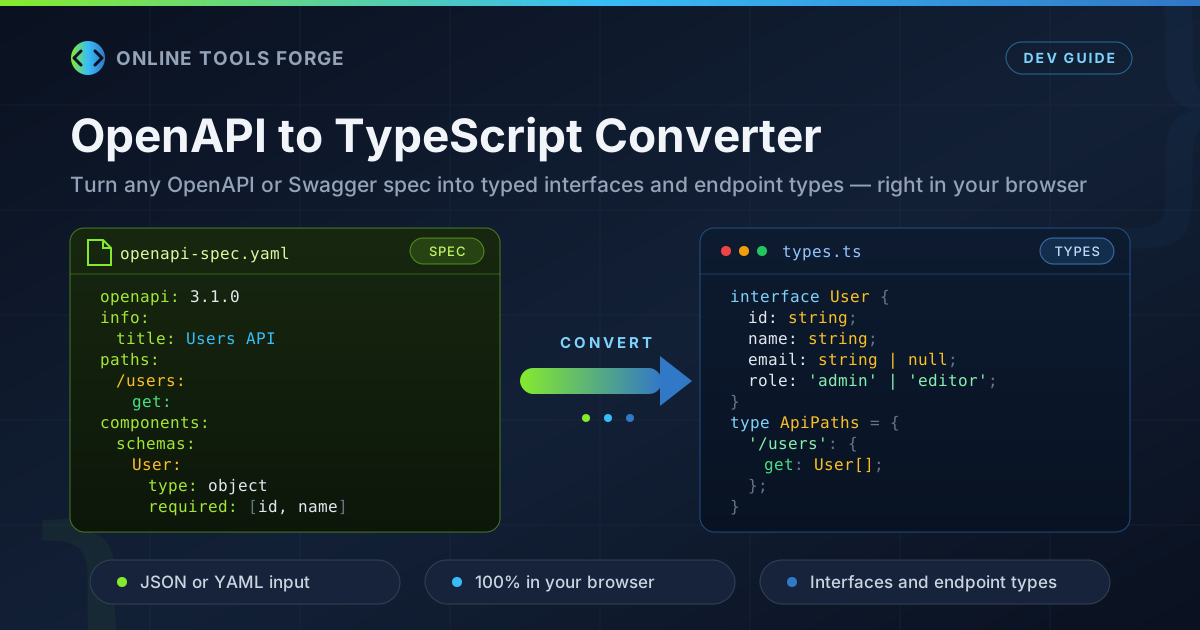
Table of Contents
OpenAPI to TypeScript Converter: Turn API Specs into Typed Interfaces in Your Browser
If you have ever consumed a REST API from TypeScript, you know the routine: the backend ships an OpenAPI document and you hand-write an interface for every request and response. Then the API changes, and your carefully typed User interface quietly starts lying. The OpenAPI to TypeScript Converter ends that routine — paste a spec in JSON or YAML and get clean interfaces and endpoint types in seconds, entirely in your browser.
Hand-written types drift by definition: fields get renamed, nullable flags flip, new enum values ship — and your interfaces still describe an API that no longer exists. Generated types read from the single source of truth, so they cannot drift; regenerate and the compiler shows every call site the change touches.
This guide covers how OpenAPI schemas map onto TypeScript unions and index signatures, and how to fold generated types into your workflow — nothing to install, nothing sent to a server.
Why Use the OpenAPI to TypeScript Converter?
- Types that never drift from the spec. The converter reads components/schemas and paths directly, emitting interfaces that mirror them exactly — no translation layer between contract and code.
- Zero setup. No package install, no config file, no CI job just to see a schema as TypeScript. Open the page, paste, read the output.
- Privacy by design. Processing happens 100% in your browser with a local YAML and JSON parser. Internal contracts and partner specifications never leave your machine.
- Accepts what teams actually write. Swagger 2.0 and OpenAPI 3.x documents, pretty-printed or compact JSON, and idiomatic YAML all parse fine — paste whatever your tooling emits.
- An instant feedback loop. Draft a schema, convert it, read the resulting interface — a one-paste loop that fits schema design work.
- Free and unlimited. No signup, no quota, no watermark. Copy the generated code and move on.
Key Features
| Feature | What it does |
|---|---|
| JSON input | Paste any JSON-formatted spec and it parses on the spot |
| YAML input | A local parser handles .yaml and .yml directly |
| Schema extraction | Reads components/schemas and Swagger 2.0 definitions |
| Interface generation | One interface per schema, with required and optional fields |
| Endpoint types | Request and response types per path and method |
| In-browser processing | Runs client-side; nothing uploaded, logged, or stored |
Two details deserve a callout. Recursion matters: a User schema referencing an Address schema produces both interfaces, reference wired up. Endpoint types are often the bigger win, capturing GET /users/{id} response shapes without reverse-engineering prose. Parsing is local, so a 2MB spec still converts in under a second.
How to Use
- Open the OpenAPI to TypeScript Converter in your browser — no account or installation needed.
- Paste your spec, or drop in a .json, .yaml, or .yml file. The format is detected automatically.
- Review the detected schemas under components/schemas and the endpoints under paths.
- Read the generated output: one interface per schema, plus request and response types per endpoint.
- Copy what you need into a file like src/types/api.generated.ts.
That is the whole workflow — tweak the spec, re-paste, and see how the types respond.
From Schema to Interface
The heart of the tool is the mapping from OpenAPI's JSON Schema dialect to TypeScript, and most of it is refreshingly direct:
- type: string, type: integer, and type: number map to string and number; formats like date-time stay as string.
- nullable: true appends | null to the property type, so nullable fields are modelled honestly.
- enum: [admin, editor, viewer] becomes the literal union 'admin' | 'editor' | 'viewer' — invalid values stop compiling at the call site.
- type: array with an items schema becomes ItemType[].
- allOf merges subschemas into an intersection type; oneOf and anyOf become unions, optionally narrowed by a discriminator.
- additionalProperties: true yields an index signature like { [key: string]: unknown }; a typed value yields a typed record.
On input, JSON and YAML are equals — JSON via the native parser, YAML via js-yaml in your browser. Both carry identical information, so paste whichever your pipeline emits.
Given this YAML schema:
components:
  schemas:
    User:
      type: object
      required:
        - id
        - email
      properties:
        id:
          type: string
        email:
          type: string
          nullable: true
        role:
          type: string
          enum: [admin, editor, viewer]
        tags:
          type: array
          items:
            type: string
        metadata:
          type: object
          additionalProperties: true
the converter produces:
interface User {
  id: string;
  email: string | null;
  role: 'admin' | 'editor' | 'viewer';
  tags: string[];
  metadata: { [key: string]: unknown };
}
Just as important is what generated types do not cover. They are compile-time constructs, erased at runtime, validating nothing by themselves. Constraints like minLength, maximum, and pattern have no TypeScript equivalent. When payloads cross a trust boundary, pair generated types with a runtime validator such as Zod so both layers stay in sync.
Practical Use Cases
Frontend type safety against a REST API
The most common case: a React, Vue, or Next.js app talking to a backend that publishes an OpenAPI document. Convert the spec once per release, commit the interfaces, and type every fetch wrapper with them. When a field is renamed, the next regeneration turns the drift into a compile error at build time, not a user report at runtime.
SDK scaffolding for internal libraries
When several teams consume the same API, a thin typed client saves everyone from re-declaring the same shapes. Generated interfaces hand you the data layer of an SDK in minutes; you only write transport logic (auth, retries, base URL), then regenerate per contract release.
Contract-first development
Teams that design the OpenAPI document before writing server code can convert the draft spec and hand the interfaces to backend and frontend as the shared vocabulary. Arguing about role: 'admin' | 'editor' | 'viewer' beats arguing with a paragraph of prose.
Reviewing API changes in diffs
Because generation is deterministic, a spec change produces a predictable type diff. Commit the generated file and any breaking change — renamed property, widened union, newly nullable field — shows up in the pull request with its blast radius visible.
Best Practices
- Regenerate on every spec change. Types are only as fresh as their last generation.
- Commit the generated types. Versioned output gives you reviewable diffs and a build that works before teammates regenerate.
- Add runtime validation at the boundary. Static types describe what should arrive; validators enforce what actually arrives.
- Name schemas meaningfully in the spec. Interface names come straight from schema keys — UserProfile is useful, Schema12 is not.
- Keep the spec as the single source of truth. Hand-editing a generated interface forks the contract.
- Remember types are compile-time only. They catch mistakes early but never guard a running program.
Generate Your TypeScript Types Today
Stop hand-maintaining a shadow copy of your API. Paste a spec into the OpenAPI to TypeScript Converter, take the interfaces, and let the compiler keep your client code honest — entirely in your browser, entirely free.
Related Tools You Might Like
- JSON Formatter — pretty-print and validate JSON specs before converting them
- JQ Playground — probe real API responses against your type shapes
- TSConfig Generator — strict compiler settings that make generated types pay off
Happy type generating!
Frequently Asked Questions
Q: Does the converter upload my API spec to a server? A: No. Parsing and generation run entirely in your browser with local JavaScript, YAML parser included. Proprietary contracts never leave your machine.
Q: Can it read Swagger 2.0 documents as well as OpenAPI 3.x? A: Yes. Swagger 2.0 stores schemas under definitions, OpenAPI 3.x under components/schemas; the converter reads both the same way.
Q: How are enums and nullable fields handled? A: An enum becomes a string literal union like 'admin' | 'editor' | 'viewer', and nullable: true appends | null — both encoded in the type system, not comments.
Q: Do the generated types validate data at runtime? A: No. TypeScript types are erased at runtime, so constraints like pattern or minLength are not enforced. Use a runtime validator at the system boundary.
Q: Which format should I paste, JSON or YAML? A: Either. The tool detects the format and parses both identically, so use whatever your pipeline emits.