Overtime Calculator Guide: How to Compute OT Pay with Thai Labor Law Multipliers
Learn how to compute overtime pay with 1.5x, 2x, and 3x multiplier tiers. A complete guide to the Overtime Calculator, monthly-to-hourly salary conversion, and Thai labor law presets.
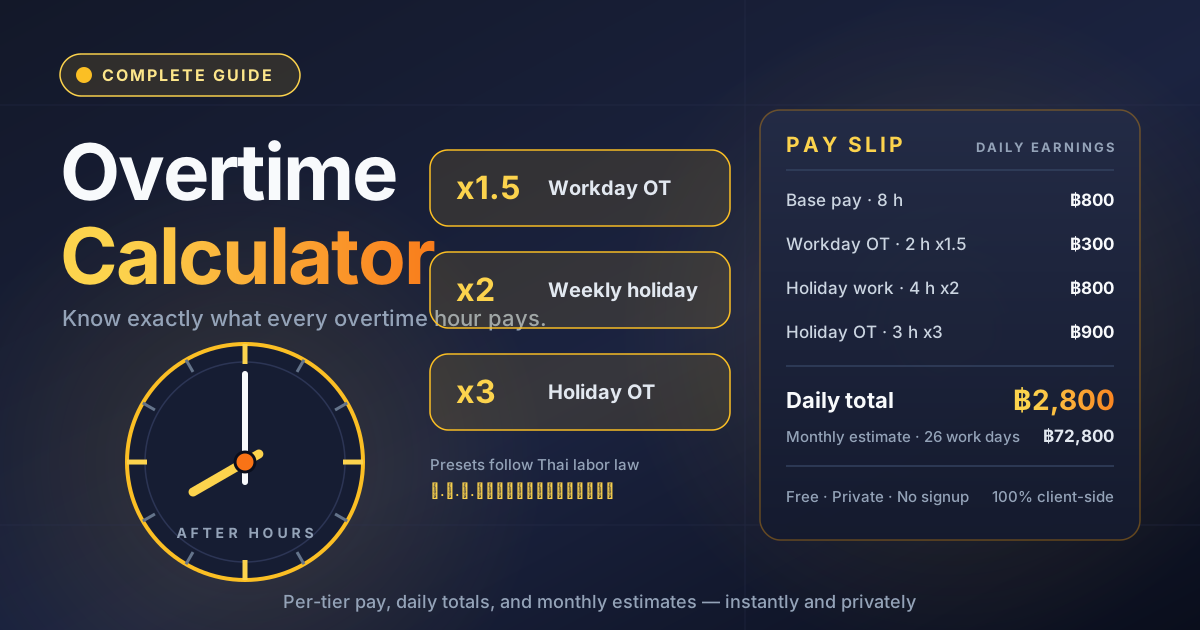
Table of Contents
Overtime Calculator Guide: How to Compute OT Pay with Thai Labor Law Multipliers
Overtime is one of the most commonly miscalculated parts of a paycheck. Stay late on a Tuesday, work a Sunday, or cover a holiday, and the applicable rate changes — sometimes several times in one week. Most people either accept their payslip or make a rushed estimate.
The Overtime Calculator removes the guesswork. Enter your base hourly rate, add hours to each multiplier tier — 1.5x, 2x, or 3x — and the tool instantly shows per-tier pay, a daily total, and a monthly estimate, with Thai labor law presets mapping every situation to its correct rate. The sections below cover each feature and work a complete example from monthly salary to weekly overtime total.
Why Use the Overtime Calculator?
- Accuracy across tiers. Evening and weekend work involve different multipliers; the calculator applies the right rate to the right hours, every time.
- Thai labor law presets. Workday overtime at 1.5x, weekly holiday work at 2x, weekly holiday OT at 3x, and traditional holiday work at 3x.
- Per-tier transparency. Each tier shows its own hours and pay, so you can pinpoint exactly where a payslip differs.
- Daily and monthly views. See today's total, then project the pattern across a month for budgeting.
- Private by design. Everything runs 100% client-side in your browser — no signup, and no wage data ever leaves your device.
- Free and instant. Results update as you type, and a one-click copy summary keeps a record for your files.
Key Features
| Feature | What It Does | Why It Matters |
|---|---|---|
| Tier-based hour entries | Separate hours for each situation | Matches how overtime accrues |
| 1.5x, 2x, and 3x multipliers | Correct multiplier applied per tier | Prevents flat-rate errors |
| Thai labor law presets | Statutory-style rates pre-mapped | Nothing to memorize |
| Per-tier pay breakdown | Pay shown for each tier alone | Fast payslip verification |
| Daily total | Regular pay, OT tiers, and allowances combined | What actually reaches your account |
| Monthly estimate | Daily pattern times work days per month | Snapshot becomes a plan |
| 100% client-side | Runs in your browser, no server round-trip | Salary data stays on your device |
Two extra touches:
- Flexible inputs. Set regular hours, currency symbol, and daily allowances — all flow into the totals.
- One-click summary. Copy the full calculation as plain text for records or HR.
How to Use the Overtime Calculator
- Enter your base hourly rate. Paid monthly? Convert first — the next section shows how (15,000 THB over 25 working days is 75 THB per hour).
- Set regular hours and options. A typical day is 8 hours; add your currency symbol and any daily allowance.
- Fill in hours per tier. Enter workday overtime at 1.5x, weekly holiday work at 2x, weekly holiday overtime at 3x, and traditional holiday work at 3x. Leave unused tiers at zero.
- Read the breakdown. The tool shows per-tier pay, total overtime hours and pay, and the daily total including regular pay and allowances.
- Project the monthly estimate. Adjust work days per month (26 is a common Thai default), then copy the summary.
Overtime Multipliers Under Thai Labor Law
Thai overtime practice is anchored in the Protection of Labour Act (พ.ร.บ.คุ้มครองแรงงาน). The law sets not only that overtime must be paid, but that the rate depends on when the work happens.
From Monthly Salary to an Hourly Rate
Every multiplier operates on an hourly rate: hourly rate = monthly salary ÷ (working days per month × 8 hours). A 15,000 THB salary across 25 working days gives 15,000 ÷ (25 × 8) = 15,000 ÷ 200 = 75 THB per hour. Use your real working-day count — the divisor changes every downstream figure.
The Four Statutory Pay Tiers
| Situation | Multiplier | Typical Example |
|---|---|---|
| Workday overtime, beyond normal hours | 1.5x | Two extra hours on a Tuesday evening |
| Weekly holiday work, within normal hours | 2x | A Sunday daytime shift |
| Weekly holiday overtime, beyond normal hours | 3x | A Sunday evening extension |
| Traditional or annual holiday work | 3x | A shift on Songkran or a public holiday |
These multipliers are statutory minimums: company policy may pay more generously, but not less — always compare against your own contract.
A Fully Worked Example: 15,000 THB Monthly Salary
Take the employee above at 75 THB per hour, and one demanding week:
- Monday to Wednesday: two overtime hours each workday evening → 6 h × 75 × 1.5 = 675 THB
- Sunday daytime (weekly holiday, within normal hours): 4 h × 75 × 2 = 600 THB
- Sunday evening (weekly holiday, beyond normal hours): 3 h × 75 × 3 = 675 THB
The tiers total 675 + 600 + 675 = 1,950 THB for the week. Repeated about four weeks a month, overtime alone adds roughly 7,800 THB — over half the base salary. Enter 75 as the hourly rate and 2, 4, and 3 hours in the matching tiers to reproduce it.
An Estimate, Not Legal Advice
Results are estimates from your inputs — good for planning and payslip checks, not legal advice. For disputes, consult HR, the Department of Labour Protection and Welfare, or a qualified lawyer.
Practical Use Cases
Employees Checking Their Payslips
Enter last week's actual hours and compare tier by tier. The separate output lets you ask precisely — "my weekly holiday overtime at 3x is two hours short" — instead of complaining vaguely.
HR and Payroll Teams Running Spot Checks
Payroll systems stumble when shifts cross tier boundaries. Compute a sample week independently and compare it with the system output to catch configuration errors early.
Managers Budgeting for Overtime
Model a crunch scenario — eight people, two OT hours each, plus one weekend day — and the monthly estimate shows the true budget impact of overtime versus hiring.
Freelancers Pricing Weekend and Holiday Work
Many freelancers borrow the tiers as pricing convention: 1.5x evening rush, 2x weekends, 3x holidays — a structure the calculator turns into concrete quote numbers.
Best Practices
- Verify policy against law. Statutory tiers are the floor; a generous company policy can exceed them.
- Keep an hour log. Record dates, hours, and tiers — logged data turns a dispute into a simple audit.
- Pick the correct tier per day type. Sunday daytime (2x) and Sunday evening (3x) differ; misclassifying skews everything.
- Convert salary with your real schedule. A generic 30-day divisor understates your rate if you actually work 25 days.
- Save every summary. Keep each breakdown beside its payslip so questions resolve in minutes, even months later.
- Recheck after schedule changes. Holidays and shift swaps change which tier applies — recalculate rather than reuse an old total.
Start Computing Your Overtime Pay Today
Every extra hour has a defined value — you just need the right multiplier on the right hours. The Overtime Calculator shows the breakdown instantly, privately, and free, with Thai labor law presets built in. Check it before your next payslip arrives.
Related Tools You Might Like:
- Business Days Calculator — count working days between dates for schedules and payroll periods.
- Time Duration Calculator — add up hours and minutes across shifts to find exactly how long you worked.
- Tax Calculator — estimate income tax to see what your overtime is worth after tax.
Fair hours, fair pay — know your worth before the next shift ends!
Frequently Asked Questions
Q: How do I calculate my hourly rate from a monthly salary?
A: Divide salary by working days per month, then by 8: 15,000 THB over 25 days equals 75 THB per hour — enter that as the base hourly rate.
Q: Which multiplier applies on a weekly holiday in Thailand?
A: Work within normal hours on a weekly holiday pays 2x, hours beyond normal hours pay 3x, and traditional or annual holiday work pays 3x.
Q: Are the results legally binding?
A: No. The output is an estimate for planning and payslip checks, not legal advice. Formal disputes belong with HR or the labour department.