Ovulation Calculator: Estimate Your Fertile Window and Next 3 Cycles
Estimate your ovulation day and 6-day fertile window from your last period start and average cycle length. See peak fertility days, your next expected period, and the best pregnancy test day, with projections for your next 3 cycles. Free, private, no signup.
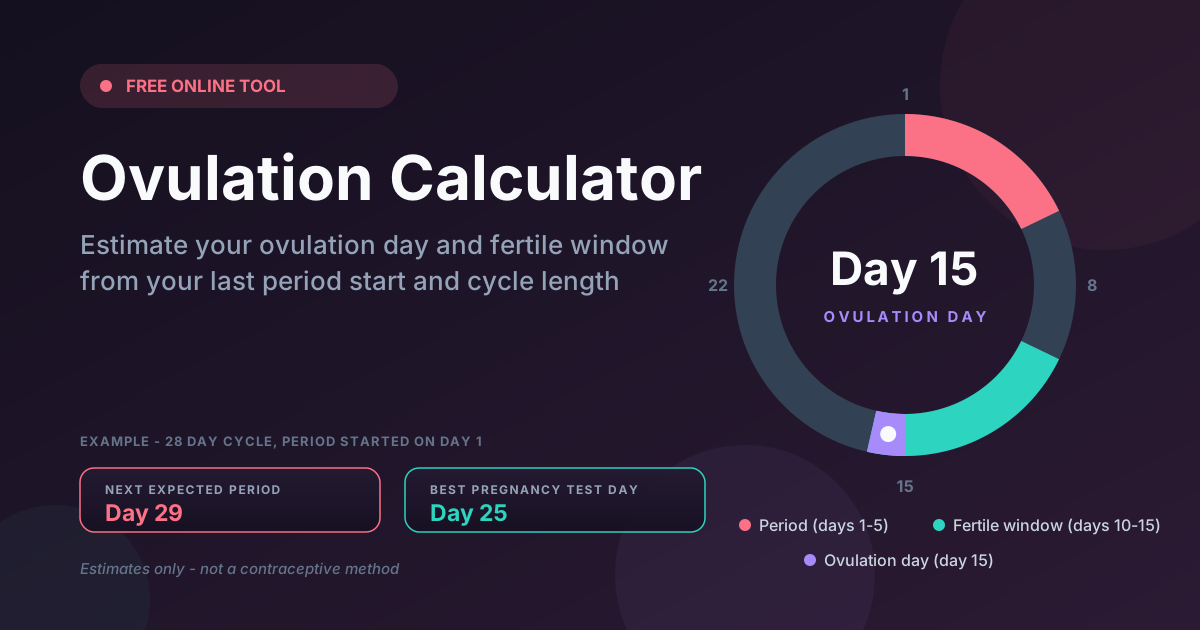
Table of Contents
Ovulation Calculator: Estimate Your Fertile Window and Next 3 Cycles
People have marked the first day of their period on paper calendars for generations — the calendar method is the oldest fertility tool there is. The arithmetic never changes, but doing it by hand each month is slow and easy to fumble. Our Ovulation Calculator does that arithmetic instantly and privately: enter the first day of your last period and your average cycle length, and it estimates your ovulation day, 6-day fertile window, peak fertility days, next expected period, and the best day to take a pregnancy test.
It also projects the same picture across your next 3 cycles, turning a one-off answer into a planning horizon. Everything runs in your browser: no signup, nothing stored, nothing you type ever leaves your device.
One note before we begin: this is a planning aid built on calendar math, not medical advice. The estimates are approximations, not promises — not a contraceptive method and not a fertility diagnosis, a point we return to throughout this guide.
Why Use Ovulation Calculator?
- Instant, complete estimates — Ovulation day, fertile window, peak days, next period, and a suggested test day appear the moment you enter two values.
- Private by design — Every calculation happens on your device. No account, and no health data collected, stored, or transmitted.
- Three-cycle projections — See where your next 3 cycles are expected to fall, giving you roughly three months of planning room in one visit.
- A best-test-day hint — The tool flags the earliest sensible day to test, so you are less likely to test too early and misread the result.
- Respects real cycle lengths — Cycles of 21 to 35 days are normal, and the calculator works with your actual average instead of assuming everyone runs on 28 days.
- Free and friction-free — No paywall, no install, no email; it works the same on phone, tablet, or desktop.
Key Features
| Feature | What It Does |
|---|---|
| Simple inputs | Two fields: first day of your last period and your average cycle length |
| Estimated ovulation day | Projects the day ovulation is most likely to occur in your cycle |
| 6-day fertile window | Shows the five days before ovulation plus ovulation day itself |
| Peak fertility days | Highlights the days with the highest chance of conception within the window |
| Next expected period | Tells you when your next period is projected to start |
| Best pregnancy test day | Suggests the earliest day a test is likely to give a meaningful result |
| Next 3 cycles | Repeats the full projection for the following two cycles as well |
| Fully private | Runs entirely in your browser with no signup and no data collection |
- One input refreshes everything. Change your cycle length and every date and projection recalculates instantly.
- Built for a sensitive topic. The interface is calm, factual, and free of ads or nagging prompts.
How to Use
- Open the tool. Navigate to the Ovulation Calculator page — no signup needed.
- Enter the first day of your last period. Pick the day bleeding started, not the day it ended.
- Enter your average cycle length. Count from the first day of one period to the first day of the next, averaged over a few cycles; most people fall between 21 and 35 days.
- Read your results. You get your estimated ovulation day and 6-day fertile window, plus peak fertility days, your next expected period, and the best pregnancy test day.
- Check the next 3 cycles. Review the projections, then re-enter fresh data when your next period starts.
How the Estimate Works
The calculation rests on one well-documented observation: the two halves of a menstrual cycle behave differently. The follicular phase — from the first day of your period to ovulation — varies widely, while the luteal phase — from ovulation to the next period — is comparatively stable at around 14 days. That asymmetry makes the math possible: your next expected period is your last period start plus your cycle length, and ovulation is estimated as the next period minus 14 days. The tool works backwards from a date it can project to a date it cannot observe.
Around that ovulation day sits your fertile window. Sperm can survive in the reproductive tract for up to 5 days, while an egg is viable for roughly 24 hours after release. Pregnancy is therefore possible across the 5 days before ovulation plus ovulation day itself — a 6-day window — with the peak fertility days being the two or three days ending at ovulation, when odds are highest.
The best pregnancy test day follows a different clock. Home tests detect the hormone hCG, which becomes measurable only after a fertilized egg implants, typically 6 to 12 days after ovulation. The tool suggests a day a few days before your expected period as the earliest sensible test date; results are most reliable on or after the day your period is due.
Here is the worked example. Suppose your period started on the 1st and your average cycle is 28 days. Your next period is projected for the 29th; counting back 14 days puts estimated ovulation around day 15 — the 15th of the month. Your fertile window spans days 10 through 15, peak fertility days fall around days 13 to 15, and the suggested test day is around day 25.
Now the honest part. Cycle lengths between 21 and 35 days are all normal, which is why the "day 14" folklore fails so many people. But if your cycles are irregular, an average of widely varying lengths describes none of your real cycles well, and calendar estimates become unreliable. Stress, illness, travel, and breastfeeding can shift ovulation in any given cycle. Treat every date as an approximation: these estimates are not a contraceptive method, cannot confirm whether you ovulated, and cannot diagnose fertility or pregnancy. For medical questions, consult a doctor or qualified health professional.
Practical Use Cases
Trying to Conceive
The hardest part of trying to conceive is rarely the biology — it is the timing. Knowing which 6 days matter each cycle replaces guesswork with a plan, and many people cross-check the dates with body signs such as basal body temperature or ovulation predictor kits.
Planning Around Your Cycle
If your energy or comfort follows a pattern, a three-month projection helps you place long flights, race days, or big presentations with fewer surprises.
Understanding Your Body
Most people learn a "textbook cycle" and never map it onto their own. Seeing your ovulation day, fertile window, and next period as real dates shows what a normal month looks like for you.
Preparing for a Doctor Visit with Data
Arriving with numbers makes the conversation easier. Bring your average cycle length, how much it varies, and the dates you have tracked — a clinician can do far more with three months of observations than with "it feels irregular."
Best Practices
- Track at least 3 cycles before trusting the average. One cycle length is a weak input; an average across 3 or more makes the projections meaningful.
- Combine calendar math with body signs. Basal body temperature, cervical mucus changes, and ovulation predictor kits each add signal a calendar cannot.
- Re-enter your data every cycle. The tool stores nothing by design, so each new period start date keeps the estimates honest.
- Treat the fertile window as a range, not a deadline. Ovulation can shift by a day or two in a perfectly normal cycle.
- Be cautious with irregular cycles. If your cycle length swings widely, treat results as rough context and raise the pattern with a doctor.
- Remember what the tool cannot do. It projects likely dates; it cannot confirm ovulation happened, detect pregnancy, or replace medical advice.
Start Estimating with the Ovulation Calculator Today
A little arithmetic, done instantly and privately, replaces a lot of guesswork. Open the Ovulation Calculator, enter two dates, and see your estimated ovulation day, fertile window, and next 3 cycles.
Related Tools You Might Like:
- Date Calculator — add or subtract days from any date, or find the gap between two dates.
- BMI Calculator — check your Body Mass Index and understand your healthy weight range.
- BMR and TDEE Calculator — estimate your daily calorie needs and support your overall health planning.
Here is to planning with clarity and meeting your body's rhythm with confidence.
Frequently Asked Questions
Q: How accurate are the estimates?
A: For regular cycles, estimates usually land within a few days of reality, but ovulation can shift in any given cycle. Treat results as a well-informed approximation and confirm with body signs or test kits if precision matters.
Q: Is my data private?
A: Completely. It runs entirely in your browser: your dates are never sent to a server or attached to an account, there is no signup, and closing the tab erases everything.
Q: Can I use this tool to avoid pregnancy?
A: No. Calendar estimates are too approximate to serve as contraception; the rhythm method has well-documented failure rates even with regular cycles. Please talk to a doctor or pharmacist about reliable contraceptive options.
Q: Do the estimates still work with irregular cycles?
A: Much less reliably. An average of widely varying lengths describes no single cycle well, so the dates become rough context. If irregularity is new or concerning, discuss it with a healthcare professional.