Roofing Calculator: Estimate Roof Area, Shingles, and Cost Before You Buy
Free roofing calculator. Estimate roof surface area from footprint and pitch, get shingle bundles or sheets, underlayment rolls, roofing squares, and cost. Gable and hip roofs, imperial and metric, 100% client-side.
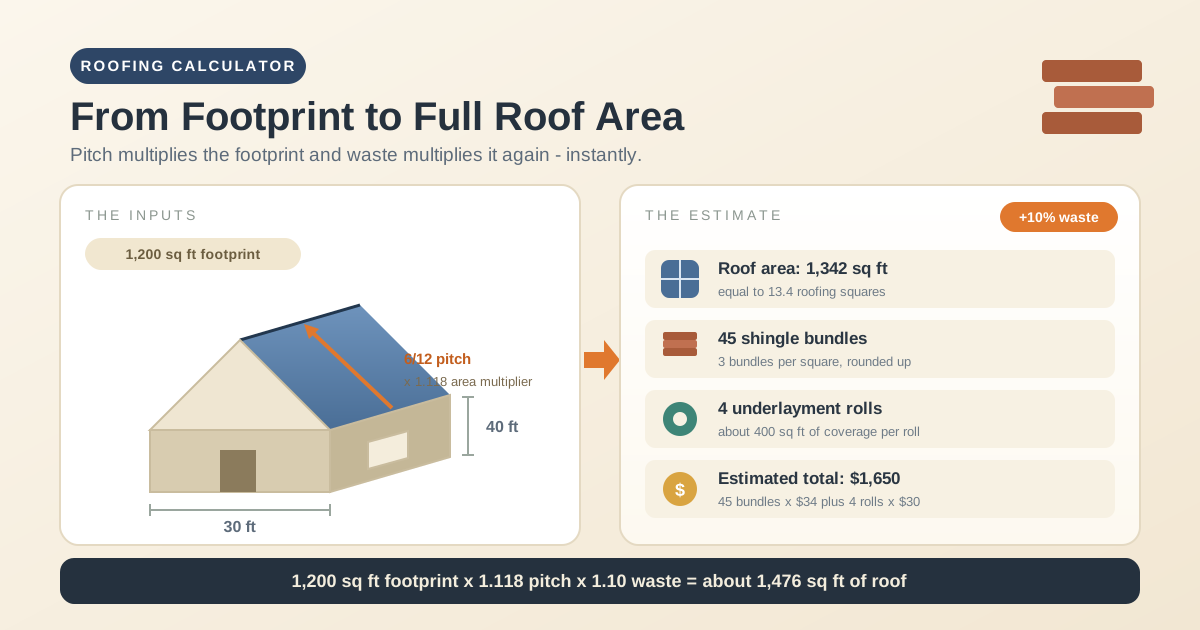
Table of Contents
Roofing Calculator: Estimate Roof Area, Shingles, and Cost Before You Buy
Roofing starts with a number most people get wrong: the size of the roof. Your roof is not the size of your house. Roof area is always bigger than the footprint, because pitch multiplies the footprint, and material waste multiplies it again. Guess from the floor plan alone and you will underestimate twice before spending a dollar. The free roofing calculator runs both multipliers for you, turning a short measuring session into a realistic materials list.
The tool takes the inputs that actually drive the answer: footprint length and width, roof pitch, roof type, and a waste allowance. From there it reports the true sloped area in roofing squares, shingle bundles or metal sheets, underlayment rolls, and a cost estimate once you enter local prices. Gable and hip geometries are supported, with imperial and metric switches to match your supplier. Everything runs 100% client-side — no signup, no uploads, and every figure updates as you type.
Why Use Roofing Calculator?
- The pitch multiplier is easy to get wrong. A 6/12 roof has about 12 percent more surface than its footprint; a 12/12 roof has 41 percent more. The tool applies exact geometry.
- Squares and bundles confuse everyone. Shingles are ordered in roofing squares of 100 square feet and sold roughly three bundles per square. Hand-converting invites slips.
- Underlayment is a separate purchase. The layer beneath the shingles is bought by the roll, and the tool tracks it alongside your main material.
- Gable and hip roofs waste differently. A hip roof folds four slopes together and generates more cuts, so it deserves a larger allowance.
- Imperial and metric, side by side. Enter rise-per-12 or degrees and read answers in the units your lumberyard uses.
- Private and instant. All math runs locally with no account, so you can rehearse a dozen scenarios before committing to one.
Key Features
| Feature | What You Enter | What It Does |
|---|---|---|
| Footprint size | Building length and width | Sets the plan area everything scales from |
| Roof pitch | Rise per 12, or degrees in metric | Converts flat footprint into sloped area |
| Roof type | Gable or hip | Adapts ridge geometry and cut complexity |
| Material mode | Shingle bundles or metal sheets | Counts whichever product you plan to buy |
| Waste allowance | 10 percent default | Pads for cuts, damage, and starter courses |
| Coverage rates | Bundles per square, roll coverage | Turns area into purchasable stocked units |
| Cost inputs | Price per bundle, sheet, and roll | Produces a complete materials budget |
- Live recalculation: change the pitch or waste and every downstream number — area, squares, bundles, rolls, cost — updates in the same keystroke.
- A transparent chain: footprint, multiplier, area, squares, and unit counts stay visible in order, so any figure can be audited.
How to Use
- Measure the footprint. Walk the outside of the building and record length and width, including overhangs you plan to cover. Feet or meters both work.
- Enter the pitch. Imperial users enter rise per 12 — a 6/12 roof rises 6 inches per 12 of run. Metric users enter degrees.
- Pick roof type and material. Choose gable or hip, then shingles or metal sheets. The mode decides whether results arrive as bundles or sheets cut to the slope length.
- Set waste and coverage rates. Defaults — 10 percent waste, 3 bundles per square, about 400 sq ft per roll — suit a straightforward gable. Raise waste to 15 percent for hips and cut-heavy layouts.
- Read results and cost. The tool reports area, squares, bundles or sheets, and rolls. Enter unit prices for a total, then round up to what your supplier sells.
Footprint, Pitch, and the Waste Multiplier
The whole estimate rests on one relationship: for a regular gable or hip roof with equal pitch on every slope, roof surface equals footprint times the pitch multiplier. The multiplier is slope length per unit of run — sqrt(144 + rise squared) divided by 12 in imperial, or 1 divided by the cosine of the angle. Steeper roofs stretch more surface over the same footprint: a 4/12 pitch multiplies by 1.054, a 6/12 by 1.118, a 9/12 by 1.25, and a 12/12 by 1.414.
Roofers convert area to roofing squares — units of 100 square feet — because coverage is quoted that way. Three bundles of standard shingles cover one square, so each bundle handles about 33 square feet; metric labels often show roughly 3 square meters per bundle. Underlayment counts separately: a typical roll covers around 400 square feet, and the tool divides and rounds up.
Roof shape changes the waste, not the area. A gable roof has two planes and one ridge; a hip roof has four slopes meeting at hips, a shorter ridge, and far more cuts. Both yield the same footprint-times-multiplier area, but the hip produces more offcuts — hence the convention of 10 percent waste for a clean gable and about 15 percent for a hip.
A worked example: the 40 by 30 garage. The footprint is 1,200 sq ft. At 6/12 the multiplier is 1.118, giving about 1,342 sq ft of roof, or 13.4 squares. Add 10 percent waste and you are covering roughly 1,476 sq ft. At 3 bundles per square that is 45 bundles, and 400 sq ft rolls mean 4 rolls of underlayment. At $34 per bundle and $30 per roll, the estimate lands near $1,650. Run the same footprint as a hip at 15 percent waste and the count rises to 47 bundles.
Practical Use Cases
Re-Roofing Budgets
Most owners replace a roof once or twice in a lifetime, so there is no experience to lean on. Estimating bundles and rolls yourself gives a materials floor before quotes arrive, and separates shingle cost from labor.
Verifying Contractor Quotes
A quote whose square count strays far from footprint times multiplier deserves a question. Run the calculator with the contract measurements and ask: does the waste cover the valleys?
DIY Planning and Material Runs
For sheds, garages, and porches, doing it yourself is realistic if the order is right. Sheet mode handles metal paneling sized to the slope length, and the roll count sizes the underlayment run.
Insurance and Storm Claims
After storm damage, adjusters and owners sometimes disagree about roof size. An independent count of squares and bundles gives you a common-ground figure for that conversation.
Best Practices
- Measure the actual footprint, including overhangs. Eaves add material the floor plan never shows; wall-to-wall measuring is the classic cause of short orders.
- Use the pitch factor, not guesswork. A two-step pitch error swings area by more than most waste allowances.
- Round bundles up and keep leftovers. If the math says 44.3 bundles, order 45; spares from the same batch are what later repairs want.
- Raise waste for hips, valleys, and cut-ups. Dormers, skylights, and valleys all generate offcuts; 15 percent is prudence, not padding.
- Budget underlayment and fasteners separately. Small lines next to the shingle total, but a roof without rolls and nails is not a roof.
Ready to size your roof with confidence? Open the free roofing calculator, measure the footprint, and let the pitch multiplier and waste rule turn ten minutes of input into an order you place once.
Related Tools You Might Like:
- Paint Calculator — apply the same measure-first discipline to the walls under that new roof.
- Tile Calculator — the footprint-to-materials workflow applied to flooring instead of slopes.
- Unit Price Calculator — compare shingle brands and bundle sizes by true cost per unit.
Measure the footprint once, let the multiplier do the climbing — and order a roof that fits on the first delivery.
Frequently Asked Questions
Q: How do I calculate roof area from the footprint?
A: Multiply the footprint by the pitch multiplier: sqrt(144 + rise squared) divided by 12 for rise-per-12 pitches, or 1 divided by the cosine of the slope angle. A 1,200 sq ft footprint under a 6/12 pitch becomes about 1,342 sq ft of roof.
Q: How many bundles of shingles do I need per square?
A: Three bundles per square is the norm for three-tab and most architectural shingles, so each bundle covers roughly 33 square feet of a 100-square-foot square. Some heavy premium lines use four or five, so check the wrapper — the tool lets you set bundles per square to match.
Q: How much waste allowance should I add?
A: Use 10 percent for a straightforward gable and about 15 percent for hip roofs, valleys, or steep layouts. The allowance covers ridge cuts, damaged pieces, and starter courses that never appear in the raw area.
Q: Can I use metric units and is my data private?
A: Yes on both counts. In metric you enter the footprint in meters, the pitch in degrees, and coverage in square meters per bundle or roll. And the calculator runs entirely client-side — nothing you type ever leaves your device.