Tile Calculator: How Many Tiles Do You Actually Need?
Free tile calculator. Count tiles from surface and tile dimensions with grout spacing, waste allowance, and box estimates. 100% client-side.
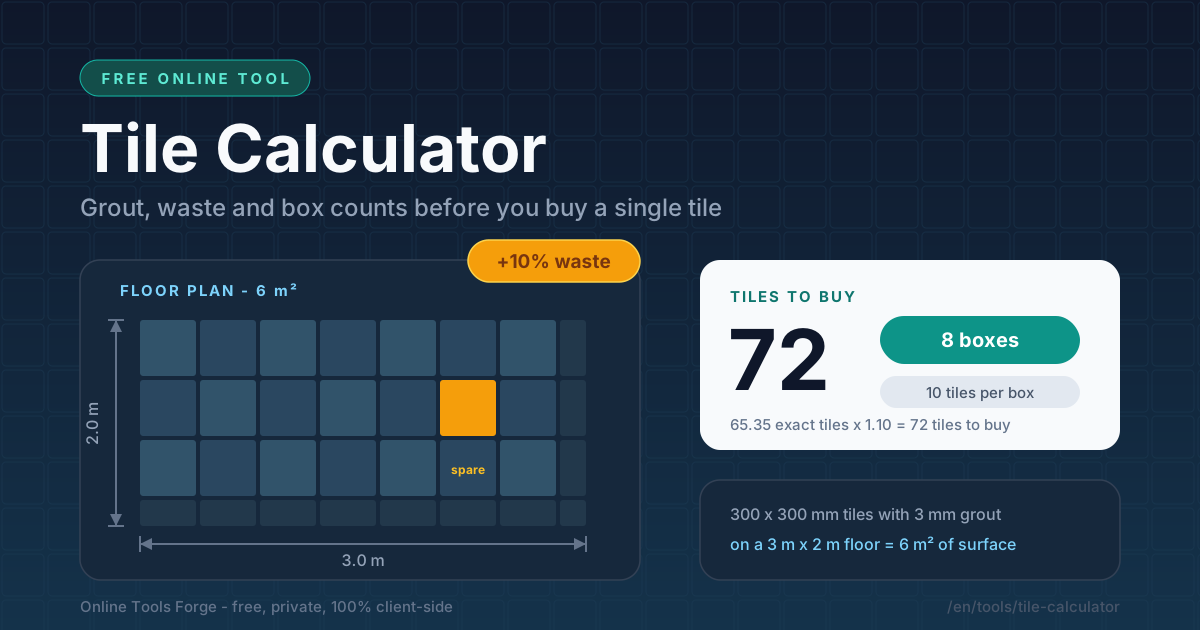
Table of Contents
Tile Calculator: How Many Tiles Do You Actually Need?
Tiles are the most permanent surface in a house and the easiest to order wrong. Tile math without a waste allowance is how projects end one tile short: the estimate covers the flat middle of the floor, then the cutter chips two pieces at the last row and the store has stopped stocking that glaze. The free tile calculator exists so your quantity survives the real room.
You enter what actually drives the order — surface dimensions, tile dimensions, grout spacing, waste allowance, tiles per box — and the tool reports exact tiles, tiles to buy including waste, box count, and total price, even the effective tile pitch. Everything runs 100% client-side in your browser: no signup, no uploads, results update as you type.
Why Use Tile Calculator?
- Grout spacing is part of the math. A 300 mm tile with 3 mm grout covers a 303 mm pitch, and the calculator builds that into every count.
- Waste allowance is built in. Cuts and breakage consume tiles; the tool multiplies the exact count by your allowance before reporting what to buy.
- Boxes, not loose tiles. Enter tiles per box and the tool rounds up to whole boxes, because that is how the checkout will.
- The cost lands before you leave the house. Add a price per box for a budget line you can compare against quotes.
- What-if comparisons take seconds. Change tile size or joint width and watch the count move.
- Private and instant. All math runs locally with no account — measure, calculate, done.
Key Features
| Feature | What You Enter | What It Does |
|---|---|---|
| Surface size | Length and width in meters | Builds the area the order covers |
| Tile size | Length and width in millimeters | Sets the footprint per tile |
| Grout spacing | Joint width in millimeters | Grows the effective tile pitch |
| Waste allowance | Percentage, 10% default | Pads for cuts, breakage, and fixes |
| Tiles per box | From the product page | Rounds up to purchasable boxes |
| Price per box | Optional, any currency | Converts boxes into total cost |
Two details make the output trustworthy:
- Transparent intermediates: the exact count before waste and the effective pitch stay visible for sanity-checking.
- Honest rounding: tiles-to-buy is rounded up, never down.
How to Use
- Measure the surface in meters at a few points — walls are rarely square, so use the larger measurement.
- Enter tile dimensions in millimeters from the listing: a "30 by 30" tile is 300 by 300 mm.
- Set grout spacing. Walls usually run 1 to 2 mm, floors 2 to 5 mm; use the width the product page recommends.
- Set waste and boxes. Keep 10% for straight layouts, raise toward 15% for diagonal or herringbone, then add tiles per box and price per box.
- Read the results and buy once — a follow-up box from a different batch is how floors end up faintly checkered.
Grout Lines Change the Math
The core formula is surface area divided by tile area — but every laid tile also owns a slice of the grout field around it. The calculator models an effective pitch of tile plus one joint per edge: a 300 mm tile with a 3 mm joint covers a 303 mm pitch, or 0.0918 m².
Grout usually lowers the count slightly. On the tool's default 3 m by 2 m floor, six square meters divided by 0.0918 m² gives 65.35 exact tiles versus 66.67 joint-free. Grout's bigger effect is at the edges, where wider joints shift every cut in the last row — exactly what the waste allowance absorbs.
Waste allowance: 10% straight, 15% diagonal. A straight grid cuts leftovers into two useful halves, so 10% covers it with room for breakage. Diagonals and herringbone turn edge tiles into triangles that rarely reuse well — 15% is the working rule.
Boxes round up, and so does the budget. 65.35 exact tiles times 1.10 is 71.89, so buy 72 tiles; at 10 per box that is 7.2, rounded to 8 boxes, and at 36 per box the total reads 288.
The half-tile-at-the-wall decision. When room width does not divide evenly by the pitch, the last row can end in a sliver narrower than half a tile — a visible mistake; tilers center the layout so both ends get equal half-tile cuts. The calculator uses the area method rather than drawing the layout, and sizes the order so those cuts are already paid for in the allowance — if cuts fall well under half a tile, start from a centered row.
The worked room. Bathroom floor, 3 m by 2 m, 300 by 300 mm ceramics, 3 mm joints, 10% waste, 10 tiles per box at 36: 6 m² ÷ 0.0918 m² = 65.35 exact; × 1.10 = 71.89 → buy 72 tiles; ÷ 10 = 7.2 → 8 boxes; 8 × 36 = 288 total. Four inputs, one delivery, no second trip.
Practical Use Cases
Bathroom Floors
Small floors amplify every cut because each is a bigger share of the room. The 3 by 2 meter floor above is 8 boxes; a 2 by 2 meter shower floor with the same tile drops to 5 boxes.
Kitchen Backsplashes
A 3 meter run under cabinets at 0.6 meter high is 1.8 m² — about 20 exact tiles, or 23 to buy at 15% waste. Every outlet is a cut, so raise the allowance before choosing between tile lines.
Outdoor Terraces
Terraces use large porcelain, often 600 by 600 mm with wider 5 mm joints for drainage. On a 5 by 4 meter terrace the count drops from 55.6 to 54.6 exact tiles at a 605 mm pitch — and cutting around drains deserves 15%.
Feature Walls
A 4 by 2.5 meter wall in 300 by 600 mm planks with 3 mm joints is 54.73 exact tiles — 61 to buy, 7 boxes. Feature walls are the most visible surface in a room, so buying one batch matters most here.
Best Practices
- Buy every box from the same batch. Shades drift between runs, and one off-batch box can be visible from the doorway.
- Keep 2-3 spare tiles forever. Leftover boxes are insurance for a cracked tile in year four.
- Dry-lay the first row without adhesive to see where cuts land; if the last row is a sliver, re-center the layout.
- Measure at tile height — out-of-plumb walls measure differently at floor and rail; use the longest measurement.
- Trust the box, not the rumor. Tiles per box varies by format; read the listing and order in full before starting.
Ready to tile with confidence? Open the free tile calculator, enter the surface, tile, grout, and waste numbers, and walk into the store knowing the exact box count and budget.
Related Tools You Might Like:
- Paint Calculator — the same discipline applied to the walls above your tiles.
- Roofing Calculator — surface-based material estimates, the exterior sibling of a tile order.
- Unit Price Calculator — compare tile lines by true price per box or per square meter.
Measure the room, mind the grout, let waste carry the cuts — and let the calculator handle the arithmetic.
Frequently Asked Questions
Q: How many 300 by 300 tiles do I need for a 3 by 2 meter room?
A: A 3 mm joint gives each tile a 303 mm pitch, or 0.0918 m²; six square meters divided by that is 65.35 exact tiles, and with 10% waste you buy 72 — 8 boxes at 10 per box.
Q: What waste percentage should I use?
A: Use 10% for straight layouts in reasonably square rooms and 15% for diagonal or herringbone; go higher for irregular rooms or fragile stone. Finish the room first, match the estimate second.
Q: Does grout spacing increase or decrease the tile count?
A: It slightly decreases it, because each tile's effective area grows to include its share of the joint — ignoring grout over-orders by a tile or two. The joint's bigger impact is shifting every edge cut, which the waste allowance absorbs.