Secret Santa Generator: Run a Fair, Reproducible Gift Exchange Online
The Secret Santa Generator draws anonymous gift exchange pairings with seeded shuffles, exclusion rules, and private reveals — fully offline in your browser.
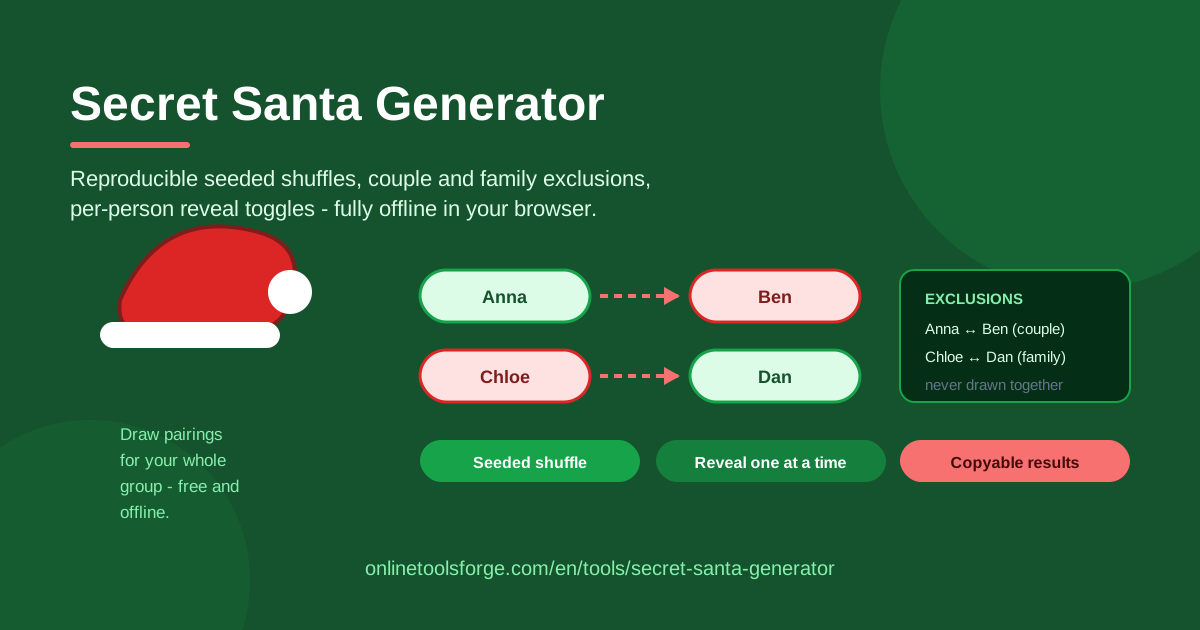
Table of Contents
A Secret Santa gift exchange sounds simple until you are the one running it. Drawing names from a hat only works if everyone is in the room, name lists pasted into group chats leak assignments, and a spreadsheet of pairings reaches the wrong inbox. The Secret Santa Generator on Online Tools Forge fixes this on a single page: type in participant names, add exclusion rules, and draw pairings instantly in your browser.
The draw uses a seeded, reproducible shuffle: the same seed with the same names always produces the identical pairing, so you can re-open the tool weeks later and recover the exact same draw. Results stay hidden until each person reveals their own assignment, the list copies anywhere, and the whole tool runs offline — nothing ever touches a server.
Why Use Secret Santa Generator?
Drawing by hand is error-prone and hard to defend when suspicions of a fix arise. A dedicated tool changes that:
- Offline privacy: every name, exclusion, and pairing is processed inside your browser — nothing is uploaded or stored on a server, which matters when the secrets are the whole point.
- Reproducible draws: the same seed with the same names always reproduces the identical result, so you can re-open the tool later and confirm exactly who drew whom.
- Exclusion rules for real life: couples, siblings, parents and children, and roommates often should not draw each other; exclusions keep those pairs out of the draw.
- Per-person reveals: assignments stay hidden behind individual reveal toggles, so each participant sees only their own pick.
- Copyable results: one click copies the full assignment list for pasting into a chat, an email, or your notes.
- Zero setup: no sign-up, no download; works on a laptop or phone, even offline once the page loads.
Key Features
| Feature | What it does |
|---|---|
| Participant list | Enter each person's name once; the list feeds the draw directly. |
| Seeded shuffle | Draw pairings with a reproducible shuffle — the same seed always yields the same result. |
| Exclusion rules | Mark people who must never draw each other, such as couples or family members. |
| Per-person reveals | Keep every assignment hidden behind its own reveal toggle. |
| Copyable results | Copy the final pairings as plain text for sharing or record-keeping. |
| Offline operation | Runs entirely in the browser with no network dependency. |
A few details worth calling out:
- Exclusions are respected while the pairing is built, not patched up afterward, so the final draw obeys every rule.
- The seed is the only state you need to keep: with it plus the same name list, any past draw can be reconstructed exactly.
- Reveals are independent per person — perfect for passing one device around a room or for remote participants.
How to Use Secret Santa Generator
Five steps, two minutes:
- Add participant names. Type in everyone taking part and double-check the spelling; the final list should be clean before you draw.
- Set exclusion rules. Add exclusions for couples, siblings, or anyone who should not be paired — easier to collect before the draw than to fix afterward.
- Draw with a seed. Enter a seed you will remember and run the draw; the same seed with the same names reproduces the identical pairing.
- Reveal one by one. Let each person flip their own reveal toggle away from prying eyes — nobody glimpses anyone else's assignment.
- Copy the results. Copy the assignment list for your records, announce the budget and gift deadline, and let the gifting begin.
How Seeded Shuffles Keep the Draw Honest
Start with what a seed actually is. A seeded shuffle feeds a starting value — the seed — into a pseudo-random number generator that deterministically permutes the participant list. Deterministic is the key word: the whole sequence of "random" decisions is fixed by the seed, so the same seed always yields the same arrangement, and changing one character changes the result completely.
That matters for three reasons. You do not have to store the results anywhere, because the draw can be reproduced from the seed and the participant list. It protects you from suspicion: with a paper draw, someone always wonders whether the organizer peeked or quietly re-drew, while a seeded draw lets you announce "one seed, one draw" up front. And distributed groups can draw together — everyone agrees on the seed in advance, and anyone who kept it can verify the pairing later.
Exclusions complicate the mathematics. A naive shuffle treats everyone as interchangeable, so it will happily assign a husband to his wife or a sister to her brother. A graph-aware pairing instead treats exclusions as forbidden pairs and searches for a complete assignment where nobody draws themselves and no excluded pair occurs. As exclusions accumulate, valid draws become rarer, so the tool builds the assignment rule by rule — and if the exclusions make a draw impossible, you learn that before any gifts are bought.
Finally, offline privacy closes the loop: the shuffle, exclusions, and reveal states all live in the browser, so the tool never sees your participants — the right default for an activity built on secrecy.
Practical Use Cases
Office gift exchanges
A fifteen-person hybrid team wants the tradition without a privacy complaint. The organizer collects names and the agreed budget, adds exclusions so managers never draw their direct reports and couples never draw each other, then draws with a memorable seed. At the party, each person reveals on the shared screen one at a time while the organizer keeps a copied backup.
Family gatherings without couple pairings
At a big family dinner, spouses should not draw each other — they already share a budget, and the fun comes from buying for someone you do not live with. The same covers parents and adult children or siblings under one roof. Exclusions untangle the whole web of relationships, and if a slip goes missing, the seeded draw is reconstructed on the spot.
Classroom parties
A teacher can run a Secret Santa among students without creating a single account: the page runs offline on a classroom laptop, so nothing about the children leaves the device — a point that reassures parents. Revealing one at a time turns the draw into a five-minute activity, with results copied in case anyone forgets.
Friend groups across time zones
Friends scattered across cities rarely share a waking hour. Instead of scheduling a live draw, the group agrees on a seed in the chat; anyone can reproduce the identical pairing to verify it, and each person reveals privately whenever their evening arrives — no coordination call, and nobody stays up until 2 a.m.
Best Practices
- Set a budget first. Agree on an amount before the draw so the pairing never influences spending.
- Collect exclusions before the draw. Ask quietly in advance; changing the participant list after a draw means a different result.
- Save the seed. Write it down somewhere safe — it is all you need to reproduce the exact draw later.
- Reveal in private. One person at a time, turning away from the group so screens stay theirs alone.
- Announce a wishlist deadline — it keeps shopping stress low and gifts on time.
- Plan for dropouts. Agree in advance whether a withdrawal means swapping assignments or re-drawing with a new seed.
Ready to retire the hat and the spreadsheet? Open the Secret Santa Generator, paste in your names, add your exclusions, and draw — takes about two minutes, needs no account, and never sends your data anywhere.
Related Tools You Might Like:
- Random Name Picker — draw a single winner or volunteer from any list.
- Spin the Wheel — turn any decision or prize giveaway into a spin.
- Random Team Generator — split any group into fair teams in seconds.
Happy gifting!
Frequently Asked Questions
Q: Do I need an account or an internet connection to use the Secret Santa Generator? A: No. The tool runs fully offline in your browser — the page just needs to load once. After that, names, exclusions, and pairings never leave your device, and no sign-up is required.
Q: What exactly is a seed, and what happens if I enter the same one twice? A: A seed is the starting value for the shuffle. The same seed with the same names and exclusions always produces the identical pairing, so you can reconstruct the draw later.
Q: Can I stop couples or family members from drawing each other? A: Yes. Add exclusion rules before drawing; the pairing engine only builds assignments that respect them, so every excluded pair is avoided.
Q: Where are the names and assignments stored? A: Nowhere except your browser. There is no server-side storage, no account, and no upload — exactly what an anonymous gift exchange needs.