Snowflake ID Decoder: Read Timestamps Hidden in Discord, Twitter/X and Instagram IDs
Decode Discord, Twitter/X, and Instagram Snowflake IDs into creation timestamps, worker IDs, and sequence numbers entirely in your browser — no signup, no uploads.
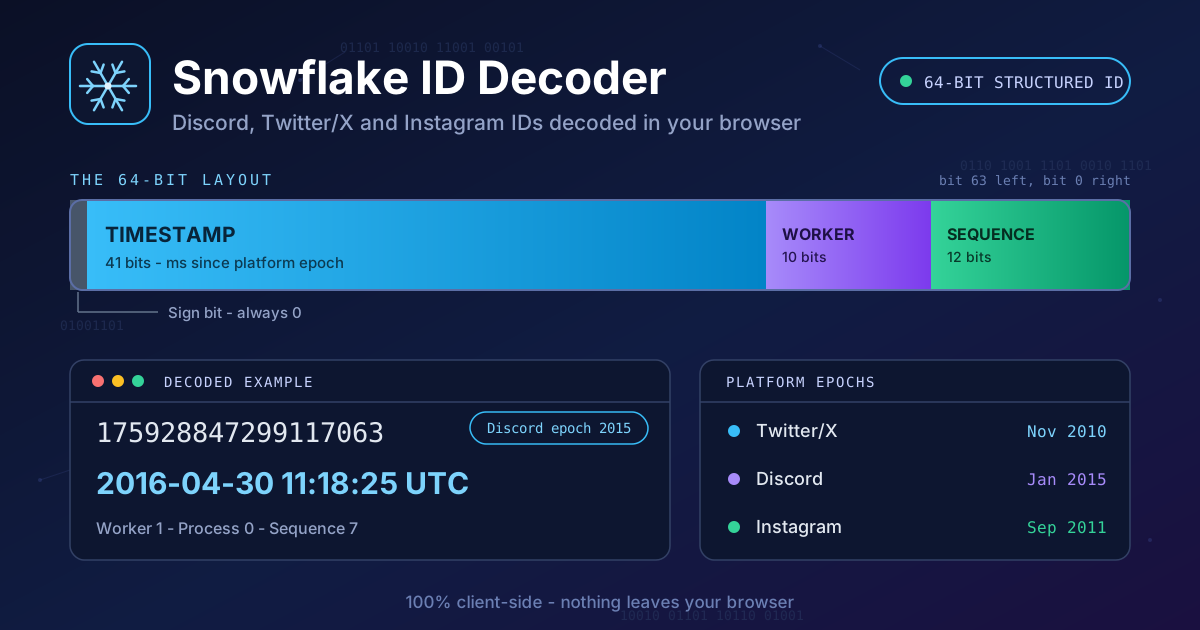
Table of Contents
Snowflake ID Decoder: Read Timestamps Hidden in Discord, Twitter/X and Instagram IDs
An ID like 175928847299117063 looks like a random number. It is not. Discord, Twitter/X, and Instagram generate their object IDs with the Snowflake scheme, a 64-bit format that packs the exact creation timestamp into the number itself. Every message ID, tweet ID, and media ID carries the moment it was born — encoded in plain sight.
The Snowflake ID Decoder reads those bits for you. Paste any ID, pick the platform, and the tool instantly breaks the value into its creation timestamp, worker and datacenter IDs, and sequence number — entirely in your browser, with nothing sent to a server.
That skill matters more than it sounds. Moderators check when an account was actually created. Analysts build timelines from IDs in logs. Developers debug pagination and rate-limit behavior in APIs. This guide shows how to do all of it in seconds.
Why Use the Snowflake ID Decoder?
- Creation dates from a single number. A user, message, or tweet ID reveals when it was created, even when the platform hides that field.
- Platform-aware epochs. Twitter/X counts from November 2010, Discord from January 2015, Instagram from September 2011. The tool applies the right epoch, so you never get a date off by years.
- The full layout, not just the timestamp. You also see the worker ID, datacenter ID, and sequence counter — exactly what you need when debugging API behavior.
- 100% client-side privacy. Decoding runs in JavaScript on your machine. No upload, no account, no logging.
- Free and instant. No signup, no limits, no install. It answers as fast as you can paste.
Key Features
| Feature | What it does |
|---|---|
| Multi-platform decode | Supports Discord, Twitter/X, and Instagram Snowflake IDs |
| Timestamp extraction | Converts timestamp bits into a human-readable UTC date and time |
| Worker and datacenter | Shows the worker and datacenter that generated the object |
| Client-side only | All computation runs in your browser; no data leaves your device |
The timestamp conversion is exact to the millisecond, and because one millisecond can hold 4,096 distinct IDs, the sequence segment tells you which one you have. The epoch selection matters just as much: decoding the same value against the wrong epoch produces a confidently wrong date.
How to Use
- Open the Snowflake ID Decoder. It loads instantly in any browser, with no installation or account.
- Paste a 64-bit ID. Copy the numeric ID of a Discord message, user, or guild; a tweet; or an Instagram media object into the input field.
- Pick the platform. Choose Discord, Twitter/X, or Instagram so the correct epoch is applied. The tool decodes live as you type.
- Read the decoded parts. The creation timestamp appears first, followed by the worker and datacenter IDs and the sequence number.
- Copy or convert the result. Take the decoded timestamp into your notes, or convert the raw milliseconds with an epoch converter for another unit or timezone.
The most common mistake is skipping step 3. A Discord ID decoded with the Twitter epoch lands years off target — an easy error to miss.
The 64-Bit Snowflake Layout
Snowflake IDs are unsigned 64-bit integers assembled from four fields:
- Sign bit (1 bit). Always zero, guaranteeing the value stays positive in every language that treats the top bit as a sign.
- Timestamp (41 bits). Milliseconds elapsed since the platform epoch. Forty-one bits cover roughly 69 years, which is why Twitter/X picked November 4, 2010, Discord picked January 1, 2015, and Instagram picked September 28, 2011. Instagram uses the same 41-bit timestamp but a 13-bit shard and 10-bit sequence.
- Worker and datacenter IDs (10 bits). The machine, and in Discord's case the process within it, that generated the ID, letting thousands of servers mint IDs in parallel without collisions.
- Sequence number (12 bits). A per-millisecond counter. When a worker mints multiple IDs in one millisecond, the sequence increments, up to 4,096 per millisecond per worker.
A Fully Decoded Example
Take Discord ID 175928847299117063, the sample from Discord's documentation. The sign bit is 0; the timestamp bits give 1,462,015,105,796, which added to Discord's epoch of 1,420,070,400,000 yields 2016-04-30 11:18:25.796 UTC; the worker ID is 1, the process ID is 0, and the sequence is 7.
Sortable by Design
This layout is why Snowflakes beat random UUIDs for high-volume systems. A random UUID v4 carries no ordering, so sorting by it reveals nothing about chronology and databases gain no index locality. A Snowflake ID is roughly monotonic: any two IDs from the same platform sort in creation order, making cursor-based pagination natural and letting databases cluster new rows.
A Note on Privacy
The flip side of built-in ordering is built-in disclosure: every Snowflake ID exposes its creation time to whoever sees it. An ID in a screenshot, log line, or API response quietly reveals when the account or file appeared. That is public metadata — but know it before you publish IDs.
Practical Use Cases
Moderation and account checks
Was an account really created years ago, or spun up yesterday? Decode its user ID — the ID shows creation time even when the client UI never does, separating long-standing accounts from throwaways.
API debugging
When pagination breaks or rate limits misbehave, the IDs in responses are the best evidence. Decoding consecutive IDs shows when each object was minted, which worker made it, and whether records return out of order — and if one worker's IDs jump backwards in time, you have found clock skew.
Data forensics and timelines
Logs, exports, and archives often contain Snowflake IDs without timestamps. Because creation time lives inside the ID, an investigator can build a timeline from IDs alone — ordering events, spotting gaps, and anchoring activity to dates.
Sorting history without a timestamp column
Tables that store Snowflake IDs as plain numbers can be ordered chronologically with a numeric sort. If a legacy table lost its created_at column — or never had one — the IDs still preserve creation order.
Best Practices
- Always pick the correct platform epoch. The same bits decode to different dates under different epochs; confirm the source platform first.
- Remember that IDs leak creation time publicly. Treat the embedded timestamp as visible metadata; if timing is sensitive in your product, do not expose raw Snowflake IDs.
- Do not build analytics on worker IDs. They describe the minting machine, not the user, and infrastructure changes over time — treat them as debugging hints.
- Handle IDs as strings. JavaScript and spreadsheets lose precision above 2^53; paste the full decimal ID as text.
- Expect the object to exist at or after the timestamp. The timestamp marks when the ID was minted, not necessarily when delivery completed.
- Verify surprises with a second ID. If a date looks wrong, decode a related ID and compare — a wrong epoch explains most discrepancies.
Decode Your First Snowflake Today
Snowflake IDs turn an opaque string of digits into a precise record of when and where — and the Snowflake ID Decoder surfaces that record in seconds, privately and entirely in your browser. Paste an ID from Discord, Twitter/X, or Instagram and watch the bits fall into place.
Related Tools You Might Like:
- UUID Decoder — break UUIDs into version, variant, and embedded timestamp fields
- Epoch Batch Converter — convert many Unix timestamps at once for bulk timeline work
- Unix Timestamp Converter — translate single Unix timestamps into readable dates
Happy decoding!
Frequently Asked Questions
Q: Can I find out who created an account from its Snowflake ID? A: No. The ID reveals when and by which worker it was minted — nothing about the person.
Q: Why does my Discord ID decode to a date that looks wrong? A: You are likely applying the wrong epoch. Discord counts from January 1, 2015 — select Discord as the platform and re-check the full value.
Q: Can two objects share the same Snowflake ID? A: No. The worker ID and 12-bit sequence guarantee 4,096 unique IDs per millisecond per machine, and different workers never collide.
Q: Does the tool accept IDs pasted from logs or spreadsheets? A: Yes, as long as the full decimal value arrives intact. Spreadsheet imports that convert large numbers to floating point will corrupt the result.