Sunrise Sunset Calculator: Golden Hour, Dawn, and Dusk for Any Coordinates
Free sunrise and sunset calculator guide. Get sunrise, sunset, solar noon, dawn, dusk, and golden hour for any date and coordinates offline with the NOAA solar algorithm — 100% client-side.
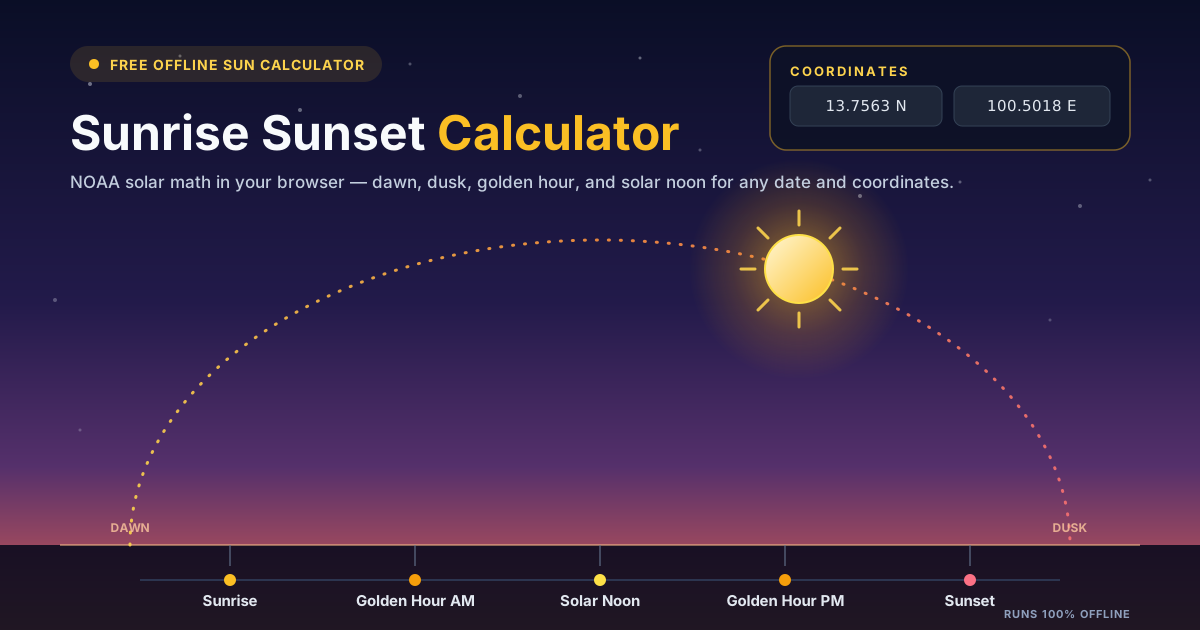
Table of Contents
Sunrise Sunset Calculator: Golden Hour, Dawn, and Dusk for Any Coordinates
Ask ten people what time the sun sets tomorrow and you will mostly get shrugs, yet that one number shapes photo trips, hike turn-around times, and when the first stars appear. The Sunrise Sunset Calculator answers it: enter any date plus latitude and longitude for sunrise, sunset, solar noon, all three grades of dawn and dusk, and both golden hour windows — computed in your browser.
Most sunrise websites lean on a city database or call a remote API. This tool runs the NOAA solar-position equations locally instead, so the page keeps working offline on a boat, at a trailhead, or in airplane mode — and your coordinates never leave your device. Below: a walkthrough, then the solar day itself.
Why Use Sunrise Sunset Calculator?
- Any date, any point on Earth. No city lists — type exact coordinates for a trailhead or a rooftop, and any past or future date works the same way.
- The full twilight ladder. Astronomical, nautical, and civil dawn and dusk are all reported, not just the moment the disk touches the horizon.
- Golden hour windows. Both windows derive from the sun's altitude, giving photographers concrete start and end times.
- NOAA-grade accuracy. The algorithm behind official government sunrise tables drives every number — within a minute or two of printed almanacs.
- 100% client-side and private. After the page loads, no network requests are made; your locations and dates stay in your browser.
- Free and instant. Enter numbers, read results — values recalculate live as you type.
Key Features
| Feature | What it does |
|---|---|
| Date picker | Full solar day for any date |
| Latitude and longitude | Decimal degrees for anywhere on Earth, land or sea |
| Sunrise and sunset | When the upper edge of the sun crosses the true horizon |
| Solar noon and day length | Arc midpoint and total daylight between rise and set |
| Twilight set | Astronomical, nautical, and civil dawn and dusk |
| Golden hour | Morning and evening windows below 6 degrees sun altitude |
| Offline NOAA engine | All math runs locally on the NOAA solar equations |
The NOAA algorithm also models refraction and the apparent solar disk, so sunrise lands slightly earlier than a naive geometric calculation, and all times appear in your device's timezone.
How to Use
- Open the tool. Load the Sunrise Sunset Calculator in any modern browser — nothing to install, no account needed.
- Pick your date. It defaults to today. Switch to your shoot or hike day; solar times shift across seasons, so the exact date matters.
- Get coordinates from a map app. In Google Maps, long-press (right-click on desktop) your exact spot and the latitude and longitude appear in decimal degrees — copy them. Apple Maps shows the same after you drop a pin and swipe up. If your source uses degrees-minutes-seconds instead, the GPS Coordinate Converter converts them in one step.
- Enter latitude and longitude. Positive means north and east, negative south and west — Bangkok is 13.7563, 100.5018; New York is 40.7128, -74.0060.
- Read and plan. Scan sunrise, solar noon, sunset, twilight, and both golden hour windows, then change the date to compare days.
Dawn, Golden Hour, and the Solar Day
The timeline of one solar day
Night dissolves in stages defined by how far below the horizon the sun sits. Astronomical dawn begins at 18 degrees below, when faint galaxies fade out. Nautical dawn at 12 degrees brings a distinct horizon with stars still up. Civil dawn at 6 degrees makes the sky bright enough for ordinary activity. Sunrise follows, golden hour lasts while the sun climbs to 6 degrees above, and solar noon marks the arc midpoint.
Who uses which band
Photographers live in the civil and golden bands, when light is soft, warm, and directional. Sailors prize nautical twilight, when the horizon sharpens but stars remain. Astronomers wait for true darkness; road planners think in civil twilight, when headlights matter.
Why latitude changes everything
Near the equator the sun sets almost vertically, compressing every band — in Thailand, civil twilight lasts about 24 minutes and darkness lands within half an hour of sunset, which is why evening light switches off so fast in Bangkok or Chiang Mai. At mid-latitudes twilights stretch. Near the poles the geometry breaks: summer brings the midnight sun, winter polar night, and twilight that lingers all night around the solstices. Same date, radically different day.
The NOAA algorithm in one sentence
The NOAA algorithm converts date and coordinates into a Julian day, derives the sun's declination and equation of time, and solves the hour-angle equation for each standard altitude.
A worked example: Bangkok on September 13
Enter 13.7563, 100.5018 with timezone UTC+7 and you get, approximately: astronomical dawn 04:55, nautical dawn 05:20, civil dawn 05:45, sunrise 06:06, morning golden hour 06:06–06:35, solar noon 12:14, evening golden hour 17:53–18:22, sunset 18:22, civil dusk 18:43 — a 12 hour 16 minute day. Note the symmetry around solar noon and the tight packing: barely 90 minutes of quality light, split dawn and dusk. December shifts it all again.
Practical Use Cases
Photography planning
Lock golden hour windows before scheduling a shoot, then step back through civil twilight for blue-hour cityscapes and astronomical dusk for star trails. One check beats arriving an hour early by accident.
Hiking and outdoor safety
Working backward from sunset gives the latest safe turn-around time on a summit trail. Civil dusk is the practical deadline for unlit terrain, especially where darkness lands fast.
Prayer time context
In the Islamic tradition, Fajr begins at true dawn and Maghrib at sunset — both direct solar events. The calculator makes a handy reference, though local authorities apply their own conventions, so community timetables stay authoritative.
Real-estate sunlight checks
Before renting or buying, run the coordinates for the winter solstice: the shortest day reveals worst-case light for a balcony or garden, and whether a west-facing living room cooks or glows in the evening sun.
Best Practices
- Enter coordinates precisely. One hundredth of a degree is about 1.1 kilometers — four to six decimals is plenty.
- Mind the timezone. Results use your device timezone; checking Iceland from Bangkok gives correct but unfamiliar clock times.
- Expect minutes of drift. Mountains block the horizon and refraction varies with weather — treat outputs as field estimates.
- Use solar noon as a sanity check. Rise and set should sit symmetrically around it; a lopsided pair means a mistyped longitude.
- Check the exact date, every time. Near the solstices times move by minutes per day, so a one-week offset shows.
- Pair night plans with moon data. Twilight says when the sky darkens; the Moon Phase Calculator says how much moonlight competes.
Plan Your Day Around the Sun
The sun runs the most reliable schedule on the planet; it surprises only those who never check. Open the Sunrise Sunset Calculator, drop in your next shoot, hike, or trip, and turn golden hour from luck into a plan.
Related Tools You Might Like:
- Moon Phase Calculator — how much moonlight joins the twilight that night
- Sleep Cycle Calculator — work backward from a pre-dawn alarm to bedtime
- GPS Coordinate Converter — turn degrees-minutes-seconds into decimal degrees
May your mornings start golden and your evenings end bright.
Frequently Asked Questions
Q: How accurate are the calculated times? A: Typically within a minute or two of printed almanacs for the coordinates entered; horizons, elevation, and refraction can shift observed events a few minutes more.
Q: Does the calculator work without an internet connection? A: Yes. After loading, the entire NOAA computation runs locally in your browser — no API calls, nothing sent anywhere.
Q: Why enter latitude and longitude instead of choosing a city? A: Sun times change measurably every twenty kilometers east or west, and city dropdowns cannot cover anchorages or summits. Exact coordinates give an exact answer anywhere.
Q: What is the difference between sunrise and civil dawn? A: Sunrise is when the disk appears at the horizon; civil dawn comes earlier, at 6 degrees below, when the sky is already bright for outdoor activity.