Thai Postcode Lookup: Find Any Thai Postcode in Seconds
Search 7,400+ Thai subdistricts by postcode or by name in Thai or English with Thai Postcode Lookup - a free, offline browser tool that returns district, province, and postcode matches instantly.
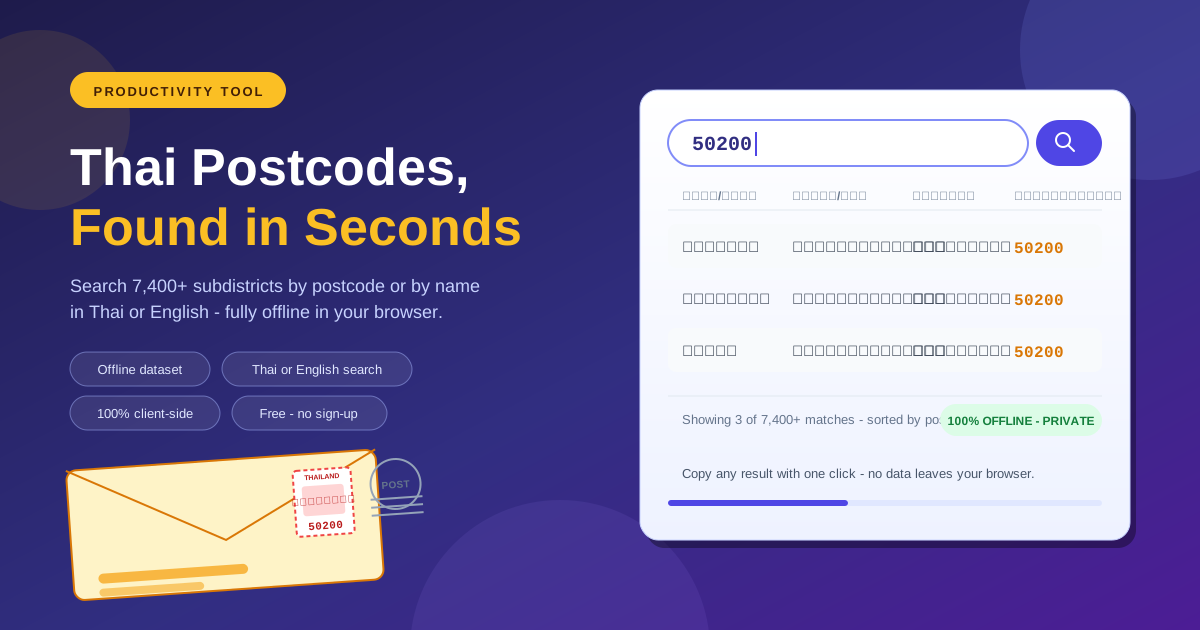
Table of Contents
Thai Postcode Lookup: Find Any Thai Postcode in Seconds
Every Thai address ends the same way: subdistrict, district, province, and a five-digit postal code. Get that final line wrong and your parcel can wander between sorting hubs for days. Thai Postcode Lookup removes the guesswork: type a postcode to see every place that uses it, or type a place name to get its postcode back.
The catch is that Thai postcodes are not one-to-one. A subdistrict can share a code with its neighbours, and a single code can span several subdistricts at once. Add romanization — the same town spelled three different ways in English — and finding the right subdistrict-district-province-postcode combination becomes a puzzle, especially without a Thai keyboard.
This guide covers how the tool works in both directions, how Thailand's five-digit postcode system is organized, and the mistakes that trip people up in checkout forms and shipping labels.
Why Use Thai Postcode Lookup?
- It works fully offline. The dataset of 7,400+ subdistricts ships with the page, so it keeps working on a plane, on patchy mobile data, or behind office firewalls.
- You can search in Thai or English. Type สุเทพ or Suthep — the tool matches both scripts and shows Thai and romanized names side by side.
- Both search directions are supported. Enter a number and get every subdistrict that uses that code; enter a name and get its code, district, and province back.
- Everything stays in your browser. The lookup is 100% client-side — your queries never leave your device, so it is safe for customer data.
- Results arrive instantly. Filtering 7,400+ records takes milliseconds, and each row shows subdistrict, district, province, and postcode together.
- It is free with no sign-up. No account, no email wall, no limit on searches.
Key Features
| Feature | What It Gives You |
|---|---|
| 7,400+ subdistrict records | Every ตำบล and แขวง in Thailand with its district, province, and postcode |
| Postcode search | Type a full or partial code to list all matching subdistricts |
| Name search in two scripts | Thai or English input, case-insensitive, matched anywhere in the name |
| Offline dataset | Works without an internet connection once the page has loaded |
| One-click copy | Copy any postcode straight to your clipboard |
| 100% client-side | Nothing you type is sent to a server; safe for confidential addresses |
A few details worth knowing:
- Partial postcode input works like a prefix explorer — typing 502 lists every code starting with 502.
- English fields use the romanized spellings from the official dataset, which usually match maps and delivery apps.
How to Use
- Open the tool. Head to Thai Postcode Lookup. Nothing to install, no settings to configure.
- Search by postcode. Type a five-digit code such as 50200 and press Enter to see every subdistrict, district, and province that shares it.
- Search by name. Not sure of the code? Type the subdistrict instead — สุเทพ or Suthep — and matching rows show the postcode alongside district and province.
- Disambiguate the result. Many place names repeat across provinces. Scan the district and province columns to pick the row matching your destination.
- Copy the postcode. Click the copy button on the correct row and paste it into your checkout form, courier label, or document.
How Thai Postcodes Are Organized
The five-digit structure. The first two digits map to the province: codes starting with 10 are Bangkok, 20 is Chonburi, 30 is Nakhon Ratchasima, 40 is Khon Kaen, 50 is Chiang Mai, and 90 is Songkhla. The remaining digits narrow the area through the district to the subdistrict delivery zone — which is why partial searches are already useful: the prefix alone tells you the province.
ตำบล and แขวง, อำเภอ and เขต. In the provinces, addresses use อำเภอ (amphoe, district) containing ตำบล (tambon, subdistrict). Bangkok uses its own pair: เขต (khet) and แขวง (khwaeng). They are the same administrative ranks with different titles, and official Thai forms expect the correct pair — ตำบล never appears in a Bangkok address. The tool's rows show the correct labels for each location.
Why one postcode covers several subdistricts. Postcodes are assigned to delivery areas, not administrative boundaries. Neighbouring subdistricts served by the same post office share a code — multiple tambon in Hat Yai all sit under 90110. The reverse happens too: a large subdistrict split across delivery routes can carry two codes. The postcode narrows the location; the subdistrict-district-province chain finishes the job.
Common checkout-form mistakes. Putting the district into the subdistrict field; accepting the first autocomplete suggestion, which propagates a wrong postcode into the wrong province; assuming a postcode uniquely identifies a place; and typing a four-digit habit from another country — Thai forms need all five digits.
Searching in English. Thai has no single official romanization, so spellings vary: Chiang Mai or Chiengmai, Phuket or Puket. Search with the shortest unambiguous stem (chiang, phra, ubon); swap ph/p or kh/k spellings if a name returns nothing; or fall back to the district name. The Thai column on the matching row gives you the authoritative spelling.
Practical Use Cases
E-Commerce Address Forms
Thai storefronts validate the subdistrict-district-province-postcode chain as one unit. When a customer reports a failed address, paste their postcode into the tool to see which subdistricts it covers, then tell them which field to fix. Sellers can also sanity-check orders before printing labels: a Bangkok postcode paired with a Chiang Mai province is a five-second catch.
Filling Thai Documents in English
Bank paperwork, lease agreements, visa extensions, and company registration forms ask for the full address chain even when you write your name in English. The tool shows both scripts on one row, so you can copy the romanized subdistrict and the postcode into the right fields without hunting through a postal-service PDF.
Courier and Shipping Operations
Rate calculators and delivery-time estimates key off postcodes, so a wrong code means a wrong quote. Operations teams can spot-check bulk recipient lists — verify each postcode against its province before importing into the shipping system. Catching rows that will bounce beats refunding parcels that never arrived.
Expat Mail and International Parcels
From abroad, the international network needs only country and city, but the last mile in Thailand needs the five-digit code. Write the street line in Thai where you can, keep the romanized province and correct postcode in Latin script, and letters survive the handoff to the local carrier.
Best Practices
- Copy the official Thai spelling for official mail. For anything routed through Thailand Post or a government office, prefer the Thai-script name from the result row.
- Double-check shared postcodes. When one code spans several subdistricts, confirm the district and province on the row before you trust it.
- Keep the full chain together. Subdistrict, district, province, and postcode form one unit. A bare postcode is not an address, and chain-validating forms reject mismatches.
- Search with short stems. Three or four letters usually find the row without guessing the exact romanized spelling.
- Use partial codes to explore. Prefix search shows an entire district's codes at a glance — useful for logistics planning.
- Re-verify after address changes. New roads and re-zoned areas occasionally shift delivery areas; a ten-second check beats a returned parcel.
Try It Now
Postcodes are the one part of a Thai address you cannot describe your way around — a form either accepts the five digits or it does not. Keep Thai Postcode Lookup open in a tab, type the code or the place, copy the answer, and move on. It is offline, private, and faster than any search engine for this one job.
Related Tools You Might Like:
- Thai Area Converter — convert between rai, ngan, square wah, and square metres for land listings and contracts.
- Thai Baht Text Converter — turn amounts into Thai baht written in words for invoices and cheques.
- Thai ID Validator — verify Thai national ID numbers with the official checksum before storing them.
Happy addressing!
Frequently Asked Questions
Q: Is Thai Postcode Lookup really offline?
A: Yes. Once the page has loaded, the full 7,400-row dataset lives in your browser and every search runs locally. You can disconnect and the tool keeps working.
Q: Why do several subdistricts share the same postcode?
A: Thai postcodes are assigned to delivery areas rather than administrative boundaries, so neighbouring subdistricts served by the same post office share a code. Always check the district and province columns to confirm the right place.
Q: The English spelling I know returns no results. What should I try?
A: Try a shorter stem such as chiang or ubon, or an alternative spelling such as Puket for Phuket. If it still fails, search the district name — its subdistricts will appear under it.
Q: Can I enter only part of a postcode?
A: Yes. A partial number acts as a prefix search — typing 502 lists every postcode starting with 502, all in Chiang Mai province.