Unit Price Calculator: Compare Prices Per Unit and Find the True Best Value
Bigger packages are not always cheaper. Learn how the Unit Price Calculator converts any pack size and price into a per kg, per liter, or per piece figure so the true best value wins — 100% offline.
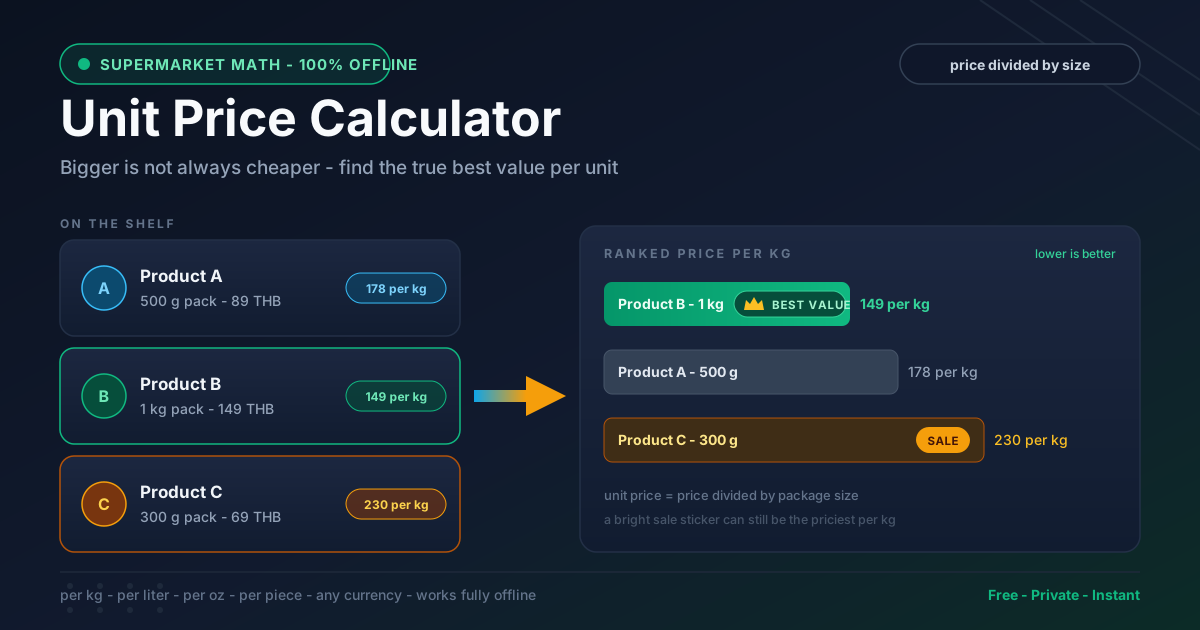
Table of Contents
Unit Price Calculator: Compare Prices Per Unit and Find the True Best Value
The biggest pack always feels like the cheapest deal, and the brightest sale sticker feels like the smartest buy. Neither feeling survives contact with arithmetic. Stores often print a unit price on the shelf, yet those labels go missing exactly for promotions, when you need them most.
The truth is that a bigger package is not automatically cheaper, and a sale is not automatically a bargain. Shrinkflation trims grams while the sticker stays identical. The free Unit Price Calculator settles it in seconds: enter each product's package size and price, and it converts everything into one common figure — price per kg, liter, ounce, or piece — then ranks the shelf so the true best value is obvious. This guide walks through the tool and runs a worked example where the loudest sale is the worst deal.
Why Use Unit Price Calculator?
What the tool brings to every trip:
- Expose shrinkflation on sight — A pack that silently drops from 500 g to 450 g at the same price jumps in per-unit terms.
- Compare mixed pack sizes fairly — A 500 g box, a 16 oz bag, and a 1.2 kg value pack rank on equal footing.
- See through sale-sticker theater — A slashed price can still be the most expensive per unit.
- Decide bulk versus regular with numbers — Quantify how much the warehouse pack really saves.
- Work in any store and currency — Baht, dollars, euros; the math is currency-agnostic and runs offline.
- Keep your shopping private — Everything computes in your browser; no list or price leaves your device.
Key Features
The Unit Price Calculator is built around one job: turning shelf prices into comparable per-unit figures.
| Feature | What It Does | Example |
|---|---|---|
| Multiple products | Add as many competing packs as you want | 3 rice bags |
| Package size and unit | Accepts kg, g, liter, ml, oz, or piece | 500 g vs 16 oz |
| Price per unit output | Divides price by size into one figure | 89 THB per kg |
| Mixed unit support | Converts g to kg and ml to L automatically | 330 ml vs 1.5 L |
| Value ranking | Cheapest per unit sits on top | Winner highlighted |
| 100% offline | Runs locally in your browser | Works in airplane mode |
- Mixed units normalized — g to kg and ml to L convert automatically.
- Live ranking — results re-sort as you type, handy mid-aisle.
- Any currency, no setup — no sign-up and no internet needed.
How to Use
- Open the calculator and add your first product. Name it something you recognize.
- Enter the package size and pick its unit. The pack label tells you which applies.
- Enter the shelf price. Use what you would really pay at the register, promotion included.
- Repeat for every competing pack — each brand, size, and multipack you are weighing.
- Read the ranking and buy the true winner. The cheapest per-unit option sits on top; apply freshness judgment, then choose.
Shrinkflation Has a Kryptonite
The entire method rests on one line of arithmetic: unit price = price ÷ package size. Divide 89 by 0.5 kg and you get 178 per kg; divide 149 by 1 kg and you get 149 per kg. Expressed per the same unit, comparison becomes a fact.
That is exactly the calculation shrinkflation is designed to avoid. When a pack shrinks from 1 kg to 900 g at an unchanged price, nothing on the sticker moves — but the per-unit price rises roughly 11 percent in one step. Brands count on you anchoring to the tag; unit price anchors to what you receive.
Beware the conversion traps. Kilograms versus grams is a factor of a thousand: 250 g at 45 works out to 180 per kg, worse than 1 kg at 160. Milliliters versus liters repeats the trick — a 330 ml can must be scaled up before facing a 1.5 L bottle. Count versus weight differs: compare piece with piece and kg with kg.
Mixed sizes are where the calculator earns its keep — consider a realistic rice aisle:
- Brand A, regular pack — 5 kg at 425, which is 85 per kg.
- Brand B, sale pack — a big red "20% OFF" sticker: 3 kg down from 345 to 276, which is 92 per kg.
- Store brand, plain bulk bag — 10 kg at 820, which is 82 per kg.
The sale pack is the worst deal despite the loudest signage. Two sale packs cost 552 for 6 kg while Brand A delivers the same for 510, and the store brand undercuts both. Only the per-unit ranking shows this at a glance.
Practical Use Cases
Everyday Grocery Runs
Keep the tool open on your phone and settle each aisle in seconds: oil, rice, detergent, coffee. A few trips in, you know a fair per-kg figure on sight, and inflated "family size" packs stop working.
Bulk Versus Regular Packs
Warehouse clubs promise dramatic savings, but the per-unit gap is often a few percent. Enter the bulk box against four regular packs, then weigh the difference against storage and upfront cost.
Restaurant and Catering Portion Pricing
Chefs and caterers live on per-unit figures. Compare chicken at 165 per kg against a 5 kg tray at 780, price napkins per piece, and cost a recipe precisely.
Subscription Per-Month Math
The same division works beyond the supermarket: an annual plan at 2,940 is 245 per month against 320 monthly. Enter duration or count as the "size" and the ranking shows the cheaper commitment.
Best Practices
- Compare the same unit only — kg against kg, liter against liter, piece against piece.
- Include packaging waste — Pump bottles, cores, and trays mean usable content is less than printed weight.
- Check freshness tradeoffs — The cheapest per kg is only a saving if you finish it before it spoils.
- Factor storage and space — A chest freezer or pantry shelf is not free.
- Recompute when prices change — Promotions rotate weekly, so yesterday's winner can become today's loser.
- Treat shelf unit-price tags as hints, not verdicts — Stores compute them inconsistently; let the calculator referee.
See the True Best Value Today
Shelf design is a century of psychology aimed at your wallet; the unit price is the number that answers back. Two minutes with the free Unit Price Calculator ranks every pack by what it really costs per kg, liter, ounce, or piece — no sign-up, nothing leaves your browser.
Related Tools You Might Like:
- Bill Splitter — Split any shared bill fairly, with tips and uneven orders handled.
- Percentage Calculator — Verify that "20% off" sticker and every discount in seconds.
- Thai Area Converter — Convert rai, ngan, square wah, and square meters instantly.
Happy comparing, and may the true best value always win!
Frequently Asked Questions
Q: What exactly is a unit price and why does it matter more than the sticker price?
A: A unit price is the cost per standardized amount — per kg, per liter, per ounce, or per piece. Sticker prices describe what you pay; unit prices describe what you get. Two packs can share a sticker price yet differ 20 percent in real value.
Q: Can I compare products sold in different units, like a 500 g box against a 16 oz bag?
A: Yes. Keep mass with mass, volume with volume — mixing per-kg and per-piece figures answers the wrong question.
Q: Is the cheapest per-unit option always the right thing to buy?
A: Not always. Freshness, storage space, and whether you will finish it before it spoils matter too. Shortlist by unit price, then apply judgment.
Q: Does the Unit Price Calculator need an internet connection or an account?
A: No. It runs entirely in your browser with 100% offline math. No sign-up, no upload — your list and prices never leave your device, so it works in airplane mode in-store.