Voltage Drop Calculator: Size Wire Before Your Lights Dim
Free online voltage drop calculator. Estimate DC, single-phase, and three-phase AC voltage drop from AWG wire size, length, current, and material with temperature correction, 3%/5% limit checks, and minimum-AWG recommendations. Works offline in your browser.
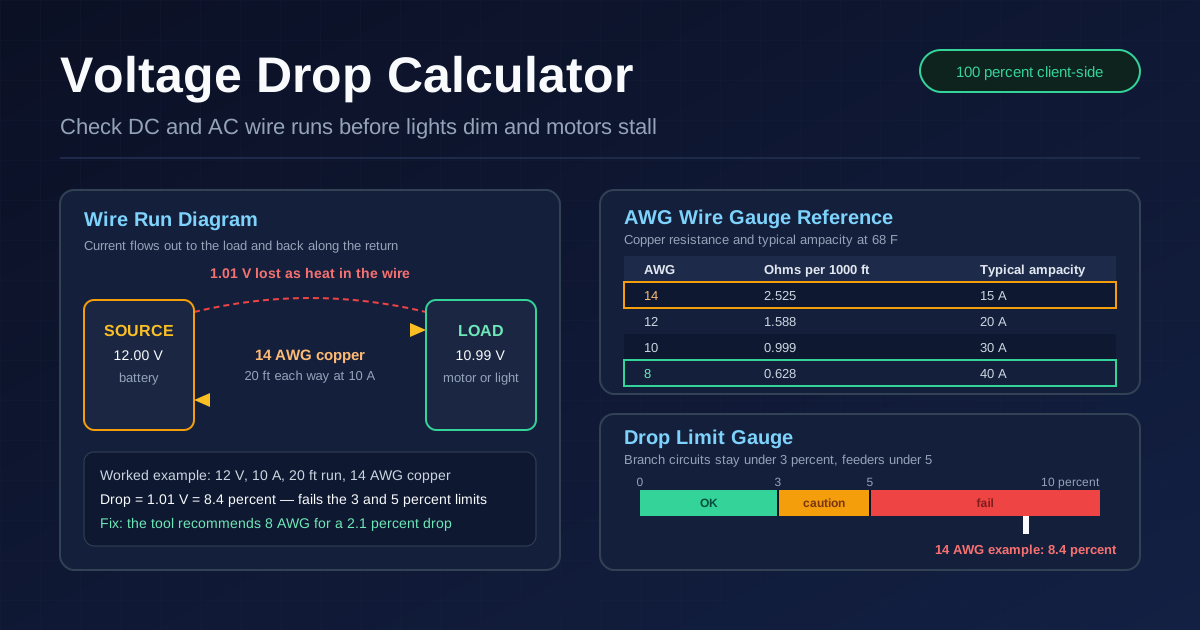
Table of Contents
Voltage Drop Calculator: Size Wire Before Your Lights Dim
Long wire runs dim lights and starve motors, and nothing looks wrong while it happens. Every conductor resists current, silently converting part of your supply voltage into heat before it reaches the load. Lights dim, pumps hum without starting, inverters trip while the battery reads healthy. Voltage drop is the invisible sizing mistake — discovered only after the walls are closed up.
The free voltage drop calculator turns that guesswork into arithmetic. Enter AWG wire size, one-way run length, current, and material — copper or aluminum — and it computes the drop for DC, single-phase AC, or three-phase AC circuits. It applies temperature correction, checks against the 3% and 5% limits, and recommends the minimum AWG that passes when your first pick fails.
Everything runs 100% client-side in your browser — no signup, no uploads, working offline once loaded.
Why Use Voltage Drop Calculator?
- It models the whole run. Current flows out and back, so a 20 ft DC run is really 40 ft of resisting conductor.
- DC, single-phase, and three-phase in one tool. Each mode applies the correct formula.
- Temperature correction is built in. Copper resistance rises about 0.4% per degree Celsius, so room-temperature sizing can quietly fail in a hot engine bay.
- It speaks the 3% and 5% language. The tool checks both branch and feeder conventions and states plainly whether you pass.
- A fix, not just a verdict. When 14 AWG fails, it recommends the minimum AWG that passes.
- Private and instant. Everything computes locally with live updates.
Key Features
| Feature | What It Does |
|---|---|
| Circuit modes | DC, single-phase, and three-phase AC, each with the correct formula |
| AWG wire sizes | Built-in resistance data for standard conductors |
| Copper and aluminum | Correct resistivity, including the aluminum two-size penalty |
| Temperature correction | Resistance scaled to your operating temperature |
| 3% / 5% limit checks | Flags results against branch and feeder conventions |
| Minimum-AWG recommendation | The smallest standard size that passes |
| 100% client-side | Runs offline; no data leaves your device |
- Material matters. Aluminum conducts only about 61% as well as copper, so matching a drop takes a conductor two AWG sizes larger.
- Context matters. An 8.4% drop is a nuisance on a 240 V heater but a genuine failure on a 12 V fridge.
How to Use
- Pick the mode. DC for battery and solar; single-phase AC for household branches; three-phase AC for feeders and motors.
- Select wire size and material. Set the AWG you plan to pull, copper or aluminum.
- Enter the one-way run length. The tool applies the round trip for DC and single-phase automatically.
- Enter current and temperature. Use steady-state draw and the real operating temperature.
- Read and act. You get volts, percent, a verdict, and the minimum AWG that passes if you fail.
Why Wires Eat Volts
The physics fits in one line: V = I × R. Each AWG size has a known resistance per 1000 ft — 14 AWG copper about 2.53 Ω, 12 AWG about 1.59 Ω, 10 AWG about 1.0 Ω, 8 AWG about 0.63 Ω. Area doubles roughly every three gauge steps, halving resistance.
The DC formula. The drop is current times wire resistance: V_drop = I × R_wire. The trap is the round trip — current returns through a second conductor, so a 20 ft run is really 40 ft resisting. Forgetting the return path flatters the result by half.
The AC versions. Single-phase AC weighs impedance by power factor: V_drop ≈ I × Z × cos(φ), and three-phase adds the √3 factor: V_drop ≈ √3 × I × Z × cos(φ). Resistance dominates short branches; reactance matters on long motor feeders.
Copper versus aluminum. Aluminum's resistivity is about 1.6 times copper's, so the same drop needs a conductor roughly two AWG sizes larger: 6 AWG copper behaves like 4 AWG aluminum.
Temperature correction. Copper resistance climbs about 0.39% per °C above the 20 °C reference, so wire sized at room temperature carries roughly 16% more resistance inside a 60 °C engine bay. The calculator applies that correction for you.
The 3% and 5% conventions. Branch circuits are held to 3% drop and the combined feeder-plus-branch path to 5%. Ignore them and the failures are predictable: lighting dims because output falls faster than voltage; motors lose torque with the square of voltage, so a 10% sag leaves 80% of the torque — a stalling pump; terminations run hot because the lost power (I²R) becomes heat where the wire is weakest.
A worked example. A 12 V battery feeds a 10 A load through 20 ft of 14 AWG copper:
- Round trip: 20 ft out plus 20 ft back = 40 ft.
- Resistance: 40 ft × 2.525 Ω/1000 ft = 0.101 Ω.
- Drop: 10 A × 0.101 Ω = 1.01 V, so the load sees 10.99 V.
- Verdict: 8.4% of 12 V — failing both the 3% and 5% limits.
- Fix: 8 AWG gives 0.25 V, or 2.1% — passing with margin.
Temperature correction would make 14 AWG look worse still — exactly the math the tool performs instantly.
Practical Use Cases
12V Automotive and Marine Runs
Low-voltage DC punishes long runs hardest because there is no headroom. A winch, a fridge at the back of a van, a trolling motor at the bow — undersized cable becomes dim lights, tripped inverters, and weak cranking. The right cable is usually two sizes larger than the parts-store default.
Solar Panel Wiring
Panels go where the sun is, not where the load is, so array-to-controller runs run long. Every volt dropped there is harvest you generated but never stored.
Workshop Extension Cords
A 15 A saw on a 100 ft light-duty cord is a recipe for hot plugs and bogging motors. Cord gauge matters as much as length — the bargain 16 AWG cord belongs on lamps.
Garden and Landscape Lighting
Landscape systems stack the odds: 12 V supplies, long runs, fixtures daisy-chained ever farther from the transformer. Near fixtures glow while the far end flickers; compute drop per leg, then upsize the trunk or split the runs.
Best Practices
- Measure the real path. Follow the routing through conduit and around obstructions, not the straight-line distance.
- Upsize one AWG beyond the minimum. The recommendation is a floor; margin covers temperature and next year's load.
- Check ampacity alongside drop. A wire can pass the voltage check and still overheat at its current.
- Size aluminum honestly. Apply the two-size rule and use connectors rated for aluminum.
- Judge by worst-case temperature. Attics, engine rooms, and conduit in afternoon sun.
- Respect small-voltage systems most. Ohms invisible at 240 V are catastrophic at 12 V.
Stop Sizing Wire by Feel
Wire is cheap; pulling it twice is not. Open the voltage drop calculator, enter your run, and get volts, percent, a verdict, and a minimum AWG in seconds — free, private, and offline-ready.
Related Tools You Might Like:
- Voltage Divider Calculator — how voltage splits across series resistances when a fraction is what you want.
- Ohm's Law Calculator — the same V = I × R law behind every drop, solved in any direction.
- LED Resistor Calculator — size the current-limiting resistor where a deliberate drop is the whole point.
Happy wiring!
Frequently Asked Questions
Q: What is an acceptable voltage drop?
A: The widely used convention allows up to 3% on a branch circuit and 5% for the combined feeder-plus-branch path. Sensitive loads like inverters and radios deserve tighter targets, and 12 V systems benefit from staying under 3%.
Q: Why does a 20 ft wire run count as 40 ft?
A: It flows to the load through one conductor and returns through another, and both conductors resist. DC and single-phase math uses twice the one-way distance; three-phase applies the √3 factor instead.
Q: Does the calculator send my values anywhere?
A: No. All computation runs client-side in your browser. Nothing is uploaded or stored, and the tool keeps working offline once the page has loaded.