Hull Speed Explained: How Fast Can Your Yacht Actually Go?
The Yacht Hull Speed Calculator turns a few spec-sheet numbers into hull speed, SA/D ratio, capsize screening value, and propeller slip in seconds.
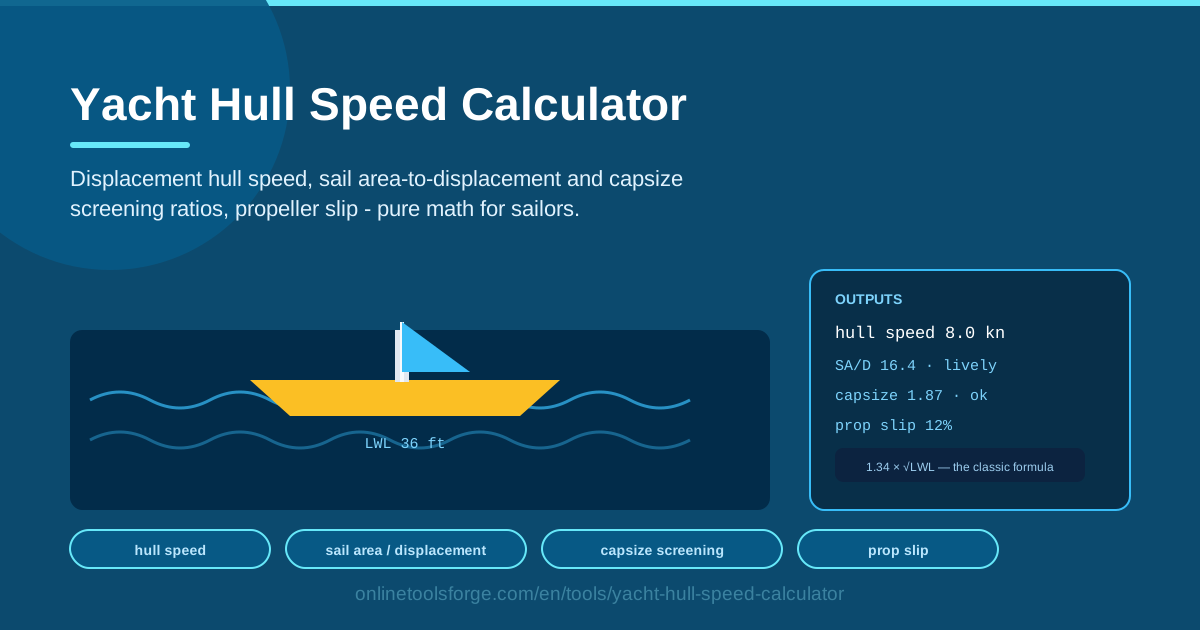
Table of Contents
Every sailor has quoted the number. Someone at the dock says their boat tops out around seven knots, and everyone nods, because everyone ran the same math: 1.34 times the square root of the waterline length. It has governed displacement boats for a century, and it is still the first calculation buyers and cruisers reach for when they want to know what a yacht can really do.
The Yacht Hull Speed Calculator puts that math, and more, at your fingertips. Enter waterline length, sail area, displacement, and beam from the spec sheet, and the tool instantly computes displacement hull speed, the SA/D ratio with a liveliness reading, the capsize screening ratio with a safety interpretation, and propeller slip from your prop data. Everything runs client-side: no installs, no account, and no data leaving your browser.
Why Use Yacht Hull Speed Calculator?
- Skip the brochure guesswork. Ads quote length overall (LOA), but hull speed depends on the shorter waterline length (LWL).
- Four ratios, one screen. Hull speed, SA/D, capsize screening, and prop slip all come from a single set of inputs.
- Interpretations, not just raw math. Plain-language readings tell you whether a boat is docile, moderate, racy - or marginal offshore.
- Fast boat-to-boat comparisons. A second yacht's dimensions give you a like-for-like comparison in under a minute.
- Completely private and instant. The math runs client-side; results appear as you type and nothing is uploaded.
- Works for any displacement hull. Sailboats, trawlers, motorsailers, and long-keel cruisers all obey 1.34 × √LWL.
Key Features
| Feature | What it does |
|---|---|
| Hull speed | Computes the practical top speed of a non-planing hull with the classic 1.34 × √LWL formula |
| Sail area-to-displacement (SA/D) ratio | Shows how lively a boat is under sail, with a docile-to-racy interpretation |
| Capsize screening ratio | Estimates vulnerability to capsize in steep breaking seas, checked against the "under 2" guideline |
| Propeller slip | Measures the gap between theoretical and actual prop advance per revolution, a direct efficiency readout |
| Client-side results | Every value recalculates instantly in the browser, with no server round-trips |
Two details worth knowing:
- The SA/D brackets follow long-standing design conventions: low numbers mean easy-driven cruisers, high numbers mean boats that need wind to shine.
- The capsize screening readout is deliberately measured, because the value is a screening tool, not a guarantee.
How to Use Yacht Hull Speed Calculator
- Enter the waterline length (LWL). The most important input; take it from the spec sheet, because hull speed scales with the square root of LWL.
- Add sail area and displacement. Sail area feeds the SA/D ratio; displacement drives both SA/D and the capsize screening ratio.
- Fill in the beam. The second ingredient in the capsize screening value - wider boats screen higher.
- Add your propeller data. Enter pitch plus observed RPM and measured boat speed to get propeller slip as a percentage.
- Read the results and interpret them. Hull speed appears first; the paired readings tell you how lively the boat is under sail and how it screens offshore.
The Numbers Every Sailor Quotes
Why displacement hulls have a speed limit. A displacement hull sits in the water rather than on it, throwing out two wave systems as it moves. As speed rises, the wavelength between the crests stretches; when it roughly equals the waterline length, the hull is trapped in the trough of its own wave system, and going faster means climbing uphill on its own bow wave. Since a wave's speed in knots is roughly 1.34 × √(wavelength in feet), the point where the wave span matches the waterline becomes hull speed = 1.34 × √LWL. A 36-foot LWL gives about 8 knots, however much canvas or horsepower you add.
SA/D: the liveliness dial. This ratio divides sail area by displacement raised to the two-thirds power, normalizing for boat size. Boats under 14 are docile but need a decent breeze to get moving; 14 to 17 is the moderate middle where most successful cruisers live; over 18 marks racy boats. A high SA/D also means the rig deserves respect - shorten sail early.
Capsize screening: the offshore comfort number. This value divides beam by the cube root of displacement. It estimates how a hull behaves in the steep, breaking seas that cause most knockdowns: wide, light boats get tossed, while narrow, heavy ones resist. Sailors long ago settled on 2.0 as the comfort threshold for offshore passages, with values under about 1.8 preferred for blue-water work. It is a coarse screen, but a high value is a reason to ask harder questions before heading offshore.
Prop slip: the efficiency you are losing. A propeller is a screw: with a 15-inch pitch, each revolution should advance the boat 15 inches. Pitch times RPM gives theoretical speed; the gap to your measured speed is slip. Ten to twenty percent is normal; thirty percent or more usually means the pitch is wrong, the prop is fouled or damaged, or the engine is lugging. Slip turns fuel into bubbles instead of boat speed, making it one of the cheapest numbers to improve.
Practical Use Cases
Comparing Two Boats Before You Buy
Choosing between a 35-foot cruiser with a 28-foot LWL and a heavier 37-footer with a 30-foot LWL? The calculator shows the first tops out near 7.1 knots, the second near 7.3. Then SA/D arrives: 15.4 versus 13.1. The lighter boat sails better in the light airs you actually encounter, while the heavier one needs real wind.
Predicting Passage-Day Speeds
You have a 60-nautical-mile leg and a boat with a 7.4-knot hull speed. Nobody holds hull speed all day: tacking, sloppy trim, and adverse current typically cost ten to fifteen percent. Plan on 6.3 to 6.7 knots of average for a nine-and-a-half-hour day.
Checking a Boat's Offshore Readiness
Before a first serious offshore delivery, run the capsize screening value. A 2.2 on a wide, lightly built boat is not an automatic no, but it is a prompt to review the stability curve and the weather windows you would accept. A 1.7 lets you close that box and focus on the rest of the list.
Validating a Prop Repitch
After repitching the prop to cure chronic lugging, record RPM and GPS speed, then feed them into the calculator. Slip that drops from 28 percent to 14 percent confirms the new pitch bites; slip that barely moves means another conversation with the prop shop.
Best Practices
- Use the real LWL from the specs. Guessing from overall length can shift hull speed by half a knot or more.
- Compare ratios within similar boat types. SA/D means something different for a heavy full-keel cruiser and a light sportsboat.
- Treat the capsize screening value as one signal. Hull form and the stability curve carry more information than any single ratio.
- Remember loading changes displacement. A cruiser full of gear, water, and fuel is heavier than the light-ship figure.
- Re-run the numbers after changes. New sails, a repitched prop, or added hardware all shift these values.
- Let conditions beat numbers on the day. A 1.6 screening value does not excuse sailing into a gale.
Numbers do not replace judgment, but they sharpen it. Open the Yacht Hull Speed Calculator, key in the spec-page figures from any brochure, and you will know in seconds whether a boat is a comfortable sitter, a lively sailer, or a handful offshore.
Related Tools You Might Like:
- Canal Boat Cost Calculator - budget the cost of slow-boat living, another world where hull speed rules every plan.
- Unit Converter - flip knots to mph, feet to metres, and pounds to kilograms when spec sheets mix units.
- Scientific Calculator - explore the formulas yourself, square roots and fractional exponents included.
Smooth seas and fair winds!
Frequently Asked Questions
Q: Is hull speed a hard limit my boat can never exceed? A: No. It is the practical ceiling for a displacement hull: beyond it, the boat must climb its own bow wave, which costs power far out of proportion to the speed gained.
Q: Which displacement should I enter - the light-ship figure or my loaded weight? A: Use the published spec-sheet figure when comparing boats, so every comparison uses the same basis. When predicting your own boat, enter your best estimate of the real weight aboard.
Q: What capsize screening value is considered safe for offshore sailing? A: The long-standing guideline is under 2.0, with many offshore sailors preferring about 1.8 or lower. Treat it as one filter among several.
Q: My propeller slip reads over 30 percent. What does that mean? A: Usually that the prop and engine are mismatched: too little pitch for the hull, a fouled or damaged wheel, or an engine lugging below its rated RPM. The 10-20 percent range is normal, so investigate.