Paint Calculator: How Much Paint Do You Actually Need?
Free paint calculator. Estimate how much paint you need from wall dimensions, coats, coverage rate, and waste. Subtracts doors, windows, and custom areas. Imperial and metric units, gallons and liters, cost estimate. 100% client-side.
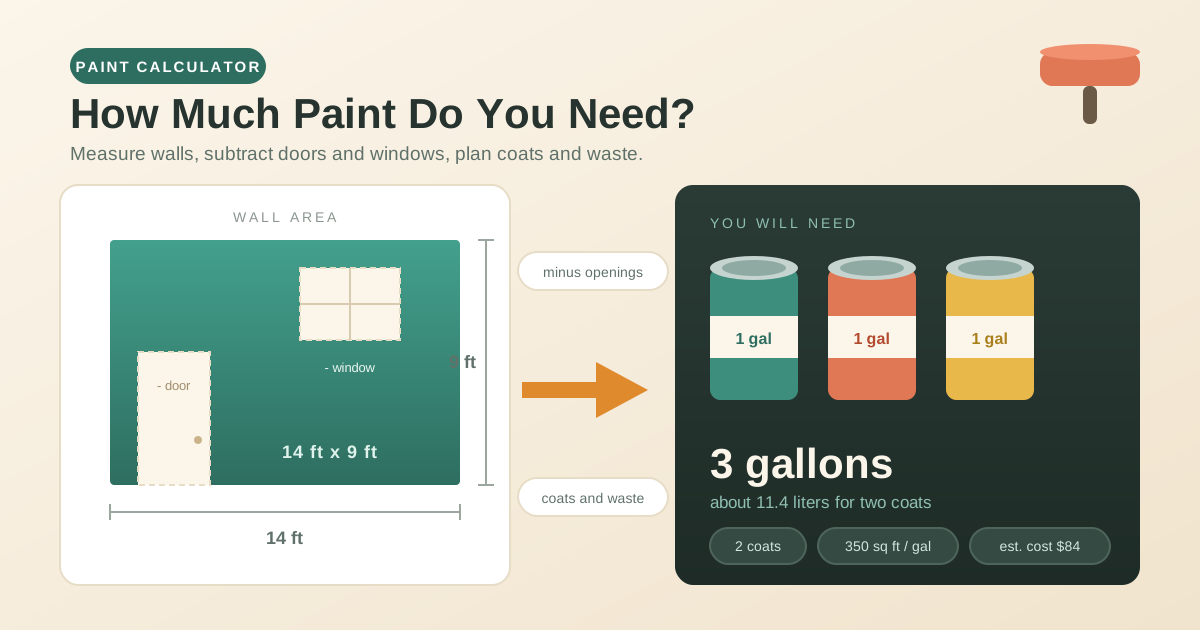
Table of Contents
Paint Calculator: How Much Paint Do You Actually Need?
Paint is one of the cheapest ways to transform a room and one of the easiest materials to buy wrong. Buy too little and you make the second trip back to the paint store mid-project — the trip you plan away with five minutes of measuring and a calculator. Buy too much and you have paid for cans slowly drying out on a garage shelf. The free paint calculator exists so you buy right the first time.
The tool takes the inputs that actually drive paint quantity: wall dimensions, number of coats, the coverage rate on the can, and a waste factor for real-world loss. It subtracts doors, windows, and custom areas, because nobody rolls color onto a windowpane. Results arrive in gallons or liters, with a cost estimate once you enter a price per unit. Everything runs 100% client-side in your browser: no signup, no uploads, and every number updates as you type.
Why Use Paint Calculator?
- It counts openings, not just walls. A door and two windows remove 45 square feet that guesses ignore — paint you will never use.
- Coats are built into the math. One coat rarely delivers the color on the chip; most jobs need two, and the tool multiplies your net area for you.
- A waste factor reflects reality. Roller splatter, tray residue, and touch-ups all consume paint. A default 10 percent allowance absorbs that loss before it absorbs your weekend.
- Imperial and metric, gallons and liters. Switch between feet and meters, gallons and liters, so the estimate matches the labels wherever you shop.
- Private and instant. All math runs locally with no account, so you can test a dozen what-if scenarios freely.
Key Features
| Feature | What You Enter | What It Does |
|---|---|---|
| Wall dimensions | Length and height of each wall | Builds the base area everything depends on |
| Opening subtraction | Doors, windows, custom areas | Removes zones you will not paint |
| Number of coats | Usually 2 | Multiplies the net area by your passes |
| Coverage rate | 350 sq ft per gallon default | Converts area into volume |
| Waste factor | 10 percent default | Pads for roller loss and touch-ups |
| Units and cost | Feet or meters, gallons or liters, price | Outputs volume and total cost |
Two details stand out:
- Live recalculation: add a window or switch to three coats, and the gallons, liters, and cost update instantly.
- Transparent arithmetic: net area, painted area, and final volume stay visible for sanity-checking against a can label.
How to Use
- Measure each wall. Record the length and height of every wall. Measure individually rather than assuming a symmetrical room — alcoves and half-walls are common.
- Enter doors, windows, and custom areas. Use standard sizes: about 21 sq ft per 3 by 7 door, 12 sq ft per 3 by 4 window, plus anything else you will skip.
- Set the number of coats. Keep the default of 2 for a normal repaint, raise to 3 for dramatic color changes, drop to 1 only when refreshing the same color on a sound surface.
- Check coverage and waste. The defaults of 350 sq ft per gallon and 10 percent waste suit smooth primed walls. Lower coverage for texture or dark-over-light transitions.
- Read the result and the cost. The tool reports gallons and liters. Enter a price per unit for the estimate, then round up to whole cans — paint is sold by the can, not the milliliter.
Coats, Coverage, and the 10% Waste Rule
The arithmetic is simple once laid out. Total wall area is each wall's length times its height, summed; subtract every opening for the net area one coat must cover; multiply by coats, add waste, divide by coverage. The calculator runs that chain — the inputs deserve some understanding.
Coverage rate reality. The famous 350 square feet per gallon is an ideal-lab figure: smooth primed drywall, light over light. Heavy texture, bare drywall, and dark-over-light transitions can drop real coverage to 250–300. If those conditions apply, lower the input and let the estimate grow — a bigger purchase still beats a second trip.
Two coats is the default for a reason. Most tinted latex paints never reach full hide in one pass, even when they look covered while wet. Three coats earn their place when going dark to light, with saturated reds or oranges, or on fresh drywall that soaks up its first coat.
Why 10 percent waste is honest. Some paint never reaches the wall: the roller sleeve holds a few tablespoons, the tray keeps a puddle, rough textures drink more. Add the inevitable touch-up, and 10 percent is a prediction, not padding — skip it and you plan to finish with zero margin.
Gallons to liters. One US gallon equals 3.785 liters; 350 sq ft per gallon is roughly 8.6 square meters per liter.
A worked example: the 14 by 12 bedroom. Walls run 14 ft and 12 ft with 9 ft ceilings, so perimeter walls total (2 × 14 + 2 × 12) × 9 = 468 sq ft. Subtract a 3 × 7 door (21 sq ft) and two 3 × 4 windows (24 sq ft) for a net of 423 sq ft. Two coats give 846; the 10 percent allowance gives about 931. At 350 sq ft per gallon that is 2.66 gallons — buy 3 gallons, roughly 11.4 liters, and at $28 per gallon the budget is about $84.
Practical Use Cases
Repainting a Single Room
Measure four walls, subtract the door and windows, keep two coats and the default waste, and you have a can count before the ladder comes down. Bedrooms land between 2 and 4 gallons, so the gap between 2.4 and 3.1 matters.
Whole-House Budgeting
Run the tool per room type and total gallons by paint line. Sheens are priced differently: knowing the kitchen needs 2 gallons of semi-gloss while bedrooms need 5 of eggshell turns a vague "painting costs a lot" into a figure you can budget.
Rental Turnovers
Landlords repaint between tenants on a schedule, and consistency compounds. One calculation per floor plan gives a repeatable order — 3 gallons per one-bedroom, 4 per two-bedroom — and leftovers carry to the next unit.
Accent Wall Planning
A 14 by 9 ft feature wall is 126 sq ft, or 252 for two coats — under one gallon even with waste. Running the numbers first stops both classic mistakes: buying a full gallon when a quart would do, or buying a quart and learning bold colors rarely cover in two.
Best Practices
- Measure each wall separately, not the perimeter once. One mis-measured alcove can push you across a can boundary.
- Round up to whole cans. If the math says 2.2 gallons, buy 3. Running short costs more in time than a spare gallon costs in money.
- Keep leftover paint for touch-ups. A sealed half-used can is exactly what you want when the hallway gets scuffed next spring.
- Trust the label coverage over marketing. Budget paints sometimes assume less than 350. Use the number on the can you plan to buy.
- Buy all cans from the same batch. Tint machines are precise but not identical, so one batch avoids a faint shade line between cans.
Ready to size your next paint run? Open the free paint calculator, measure the walls, and turn five minutes of input into a shopping list you only buy once.
Related Tools You Might Like:
- Tile Calculator — the same room-measuring discipline applied to flooring.
- Roofing Calculator — estimates roofing material, the exterior sibling of a paint estimate.
- Unit Price Calculator — compare paint brands by true unit price before committing.
Measure twice, paint once — and let the calculator handle the arithmetic between the tape measure and the checkout line.
Frequently Asked Questions
Q: How many gallons do I need for a 12 by 12 room?
A: With 9 ft ceilings, four 12 ft walls give 432 sq ft before openings. Subtract a door and window (about 33 sq ft) for 399, double for two coats (798), add 10 percent waste (878), and divide by 350 for about 2.5 gallons — buy 3. The calculator runs that chain instantly.
Q: Does 350 square feet per gallon always hold?
A: No. It is the ideal figure for smooth primed walls with light over light. Texture, bare drywall, and dark-over-light transitions commonly drop real coverage to 250–300, so lower the coverage input when they apply.
Q: How do I convert between gallons and liters?
A: One US gallon equals 3.785 liters, so 3 gallons is about 11.4 liters, and 350 sq ft per gallon is roughly 8.6 square meters per liter. The tool shows both units side by side, and since it runs 100% client-side, your measurements never leave your device.